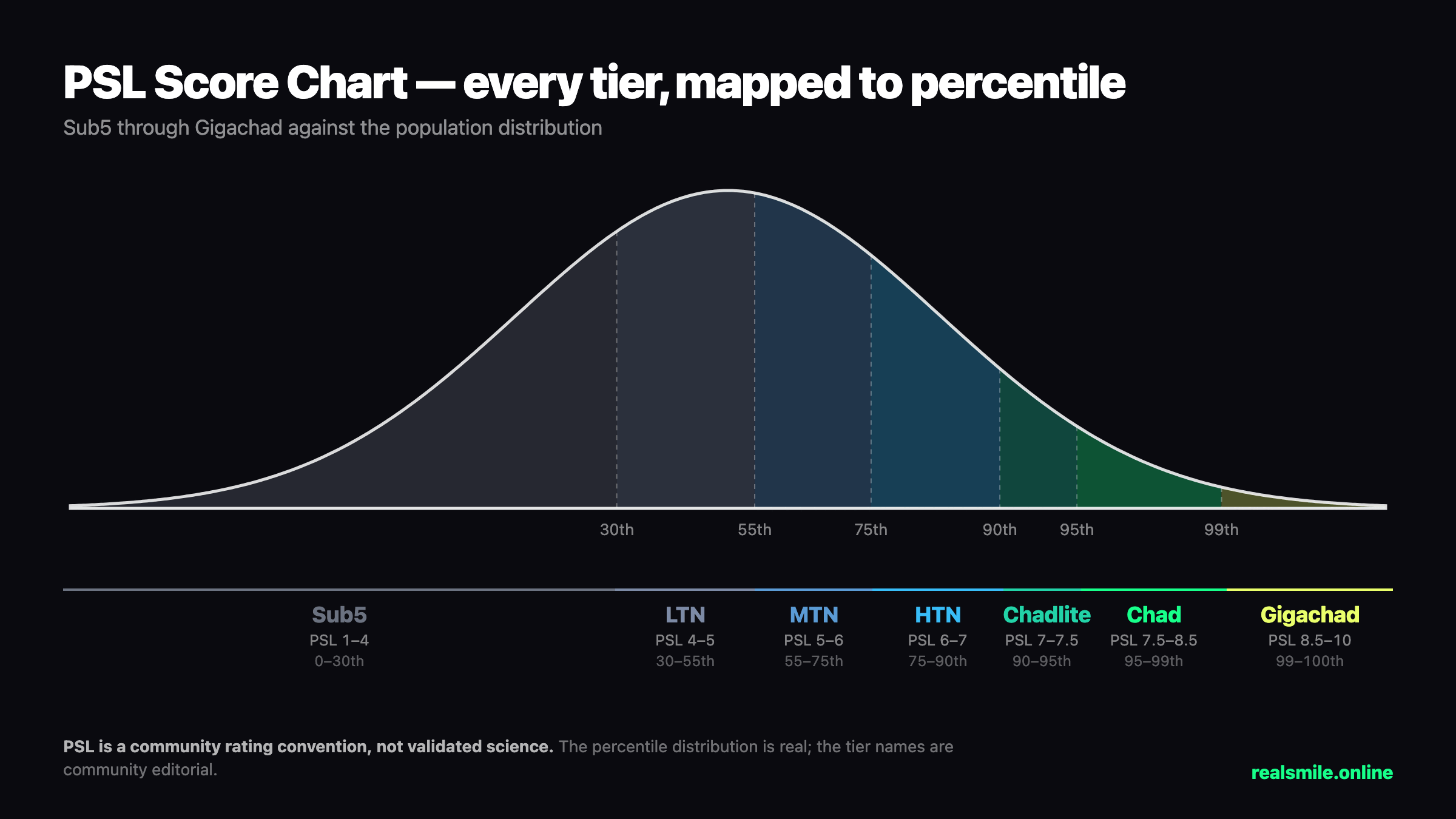
PSL tier chart at a glance
| Tier | PSL range | Percentile |
|---|---|---|
| Sub5 | 1 to 4 | Below 30th percentile |
| LTN | 4 to 5 | 30th to 55th percentile |
| MTN | 5 to 6 | 55th to 75th percentile |
| HTN | 6 to 7 | 75th to 90th percentile |
| Chadlite | 7 to 7.5 | 90th to 95th percentile |
| Chad | 7.5 to 8.5 | 95th to 99th percentile |
| Gigachad | 8.5 to 10 | Top 1st percentile |
Tap a tier for its structural markers and practical notes. Percentiles map the forum scale onto the validated Face Score distribution.
What is a PSL score?
PSL is a rating convention used on looksmaxxing forums, running from sub5 up to gigachad, that describes how a face is judged to read. It is community shorthand rather than a validated measurement. RealSmile maps the tiers onto population percentiles so you can see what band a face actually falls into.
- The tier names are forum convention, with no published validation behind them
- The Face Score behind the scan is validated at about r = 0.8 against 1,566 human-rated faces
- Free, no signup, and photos aren't stored unless you choose to save them
Reading is one thing — knowing yours is another
Measure YOUR PSL Score
Upload one selfie and the scanner measures your psl score plus 16 more — symmetry, jawline, golden ratio — in about 30 seconds. Free, no signup.
Scan my face free →Upload a selfie
Get scored, free
Unlock the report
The forum dialect, decoded
If you came to this page from a looksmax.org thread, the looksmaxxingwiki, or a Reddit rate-me post, you already speak the dialect: sub5, LTN, MTN, HTN, Chadlite, Chad, Gigachad. The vocabulary descends from PUAhate, SlutHate, and Lookism, the three early-2010s forums whose initials gave PSL its name.
Those forums are mostly gone — PUAhate was shuttered, SlutHate moved, Lookism splintered — but the rating dialect persists across looksmax.org, /r/Vindicta, /r/truerateme, and a long tail of Discord servers and Twitter accounts that still post rate-me content using the same band names.
| Term | Meaning |
|---|---|
| PSL | The initials of PUAhate, SlutHate and Lookism, the three early-2010s forums whose rating dialect this is. The forums are mostly gone; the vocabulary persists on looksmax.org, /r/truerateme and rate-me threads. |
| Sub5 | Anyone the poster judged below a 5/10 ("subhuman" in the harshest register). Thrown at anyone the poster is feeling uncharitable about — a label, not a verdict. |
| LTN | Low-tier-normie. Below average; the band with the highest practical ROI on lever work. |
| MTN | Mid-tier-normie. The default sneer for normal-looking people — a real-world 6.5 on a casual 1-to-10 scale gets called MTN. |
| HTN | High-tier-normie. Reluctantly conceded to genuinely good-looking non-models; the practical ceiling of soft-tissue and lever work. |
| Chadlite | The first of the upper bands, reserved for what would unambiguously read as model-tier in a casting room. Largely a maintenance band. |
| Chad | Reserved for the top few percent. No improvement plan in the looksmaxxing sense. |
| Gigachad | A meme escalation, used more as a meme than a measurement. Less than 1 in 100 men sit here. |
Use the band name to speak the local dialect; trust the validated percentile for the actual measurement.
The dialect is intentionally harsh and structurally pessimistic. Within the forums, "sub5" gets thrown at anyone the poster is feeling uncharitable about, "MTN" is the default sneer for normal-looking people, and the upper bands (Chadlite, Chad, Gigachad) are reserved for what would unambiguously read as model-tier in a casting room.
That compression is editorial, not measurement — a real-world 6.5 on a casual 1-to-10 scale gets called MTN in PSL because PSL anchors its ceiling harder. This chart maps the bands to fixed percentiles so the labels line up with measured structure instead of forum mood.
What the chart is for: translating a real percentile into the band name the community is going to use anyway. Your Face Score is a validated percentile — checked against how real people actually rate faces (r ≈ 0.8 across 1,566 benchmark faces), which is more than any PSL rate-me thread can claim.
Mapped to fixed percentiles: Sub5 sits below the 30th, LTN at 30th-55th, MTN at 55th-75th, HTN at 75th-90th, Chadlite at 90th-95th, Chad at 95th-99th, Gigachad in the top 1%.
The 17 geometry metrics come along as a per-feature measurement map, never blended into an attractiveness score. Use the band name to speak the local dialect; trust the validated percentile for the actual measurement.
PSL chart, PSL rating chart, looksmax chart — same ladder
The community uses the names interchangeably. A "looksmax chart", "looksmaxxing chart" or "PSL rating chart" posted in a rate-me thread is almost always the PSL ladder below: sub5, LTN, MTN, HTN, Chadlite, Chad, Gigachad.
Whether someone says they want to rate their PSL or score it, they mean this same ladder. Some servers bolt decimals onto it ("4.5 PSL") or swap a band name, but the ordering and the rough percentile spans stay the same.
So if you were sent here to find "the looksmaxxing chart," this page is it. The difference from a screenshot circulating on Discord is that the bands below are pinned to fixed percentiles from a validated score, so the same face lands in the same band regardless of which thread is rating it.
The PSL tier chart
Sub5
PSL 1 to 4Below 30th percentile- Structural markers
Multiple structural metrics measuring below their baseline ranges. Often: poor jawline ratio, soft midface, asymmetry visible at conversational distance, skin texture, recessed chin. Typically three or more drag metrics sit below baseline simultaneously.
- Practical notes
The community uses this tier most aggressively and least usefully. The largest available structural gains live here, but they are almost always soft-tissue: body composition (lower visceral fat reveals jawline), skin, posture, and grooming. Re-check with the same photo setup each time — two photos of the same face can differ by several percentile points, so one sub5 reading is not a fixed band.
LTN
PSL 4 to 530th to 55th percentile- Structural markers
Below-average baseline. One or two drag metrics (commonly skin, posture, expression default, or jawline definition) hold the overall read below average. Structural metrics are largely in baseline range.
- Practical notes
LTN stands for low-tier-normie. This is the band with the highest practical ROI on lever work. Target the specific drag metric and re-check it under matched photo conditions.
MTN
PSL 5 to 655th to 75th percentile- Structural markers
Mid-tier-normie. No metrics strongly flagged in either direction, or one or two metrics in the 75th percentile range with the rest at baseline. The face reads positively in good lighting.
- Practical notes
Moving from MTN to HTN typically requires removing one specific drag metric and amplifying one specific strong metric simultaneously. The paid report identifies both.
HTN
PSL 6 to 775th to 90th percentile- Structural markers
High-tier-normie. Multiple structural metrics in the 75th to 90th percentile range, often including a positive canthal tilt, strong jawline ratio, balanced facial thirds, and clear skin. The face reads positively across lighting and angles.
- Practical notes
HTN is the practical ceiling of soft-tissue and lever work. Moving from HTN to Chadlite typically requires structural assets that are largely set by the late twenties. Body composition, expression refinement, and photo competence carry the remaining gains.
Chadlite
PSL 7 to 7.590th to 95th percentile- Structural markers
Multiple metrics in the 90th percentile or higher. Strong structural baseline (gonial angle, FWHR, midface volume, canthal tilt all favorable), excellent soft-tissue, and habitual photo competence. The face reads as distinctly above average at first glance.
- Practical notes
This is largely a maintenance band. Sleep, skin, body composition, and recovery sustain it. Drift downward is more likely from neglect than upward from effort.
Chad
PSL 7.5 to 8.595th to 99th percentile- Structural markers
Structural assets across the board, consistent across multiple photos and lighting conditions, plus expression and presentation that compound the baseline. Rare in the general population, more common in modeling and casting filters.
- Practical notes
No improvement plan in the looksmaxxing sense. Maintenance protocols carry the entire upside in this band. Structural intervention is almost always a net negative.
Gigachad
PSL 8.5 to 10Top 1st percentile- Structural markers
Exceptional structural baseline plus exceptional soft-tissue presentation. Less than 1 in 100 men sit here against the percentile distribution. Often appears in high-fashion casting and elite professional modeling.
- Practical notes
The community uses gigachad more as a meme than a measurement. Real top-percentile faces are rare and the structural baseline is largely genetic. The score is descriptive, not aspirational.
Tracking your percentile across bands? RealSmile Pro scores with our newest model (v2) — $3.99/wk after a 3-day trial.
Reading your PSL band without forum-poisoning
+
- Stop using rate-me threads as a measurement source. The aggregate rating you get on /r/truerateme or a looksmax.org rate-me thread is a function of the time of day, the rater's own band insecurity, the photo quality you posted, and your username — not a measurement of your face. Get the validated Face Score first, then compare.
- Run the looksmaxxing test on a photo that would qualify as "rate-me-eligible" by forum standards: neutral expression, eye-level angle, even lighting, hair pulled off the forehead, no filter, no makeup if relevant. The forums will tear you apart for posting a non-rate-me-grade photo; the score does the same thing automatically, marking it as low-confidence if framing is poor.
- Translate the percentile into the band using the chart cutoffs. Sub5 to LTN territory is where the forum vocabulary is most cruel and most unreliable. If your measured Face Score reads MTN but the forums called you sub5, the forums are wrong and you are doing what most rate-me posters do: posting bad photos and absorbing the discount.
- When forum users argue your tier, ignore the loudest two voices. Forum-band consensus moves with whoever posts the longest reply; the measured percentile does not. If a thread says "Chadlite at best" but the Face Score reads Chad (95th percentile+), the thread is wrong. If the thread says "Chad easily" but the score reads HTN, the thread is being polite or trolling.
- Track the percentile across 4-week cycles, not the band label. Forum-fluent posters obsess over crossing a named threshold (LTN → MTN → HTN). The percentile is the actual measurement. A small gain that does not change your band name is still a real improvement, even if no rate-me thread will reflect it.
Why PSL specifically can be misleading
- The named tiers compress a lot of variance. Sub5 covers everything below the 30th percentile; HTN covers just 15 percentile points. Two users in the same named tier can be at very different practical positions.
- Forum vocabulary skews self-deprecating in some subforums. A user who calls themselves sub5 often measures LTN or MTN against the percentile. The measured number is more reliable than the community label.
- The named tiers do not capture expression and grooming. A face with HTN-range structure but a defaulted-closed-mouth expression reads closer to MTN in practice; the same user with a Duchenne smile and forward gaze reads closer to Chadlite.
- The tier list invites comparison-doom. Use it as a translation layer, not as a verdict. The 4-week delta you control matters more than the tier name applied at one moment.
PSL score chart FAQ
Where did PSL come from and what do the letters stand for?
PSL is community shorthand built around three forums that shaped the modern looksmaxxing vocabulary: PUAhate (the original incel-adjacent forum, mid-2010s), SlutHate (its renamed successor), and Lookism (the parallel attractiveness forum). The "PSL" acronym referenced the cluster of those communities and the rating dialect they shared.
The forums themselves are largely defunct or moved, but the rating vocabulary persists on looksmax.org and the looksmaxxingwiki, where the canonical "sub5 / LTN / MTN / HTN / Chadlite / Chad / Gigachad" ladder still gets used in tier-list threads and rate-me posts.
Why does the forum vocabulary use words like "subhuman" and "Chadlite"?
Self-deprecation is the dominant register in the original PSL forums. The vocabulary is intentionally bleak. "Sub5" or "subhuman" was used to describe anyone the poster judged below a 5/10; "MTN" (mid-tier-normie) was the default insult for "average"; "HTN" (high-tier-normie) was reluctantly conceded to genuinely good-looking non-models; "Chad" was reserved for the top few percent; "Gigachad" was a meme escalation.
The chart on this page uses the same vocabulary as the translation layer, but flatly rejects the framing — the percentile distribution is real, the names are community editorial, and "sub5" is a label, not a verdict.
What is the difference between a PSL score and a normie 1-to-10 score?
A normie 1-to-10 rating typically anchors at 5 = "average" with a wide tolerance band; most people you know on the street get rated 5 to 7 by a casual observer. The PSL ladder anchors much harder. PSL-fluent posters routinely call a real-world 6.5 "MTN" and a real-world 7.5 "HTN at most" — the forum dialect compresses the upper bands.
The chart on this page maps PSL to a fixed population-percentile distribution, so a PSL HTN here is consistently around the 75th to 90th percentile rather than a vibes-based forum verdict.
Is the "looksmaxxingwiki" or looksmax.org tier list compatible with this chart?
Roughly. The community wikis use slightly different cutoffs and some include extra tiers ("HTB" for high-tier-becoming, "Chadpreet" / "Chad Stacy" gendered variations, etc.).
The cutoffs on this chart use a fixed-percentile mapping so the bands stay numerically stable. If you saw a different cutoff on the wiki, the discrepancy is naming convention rather than measurement. Use the percentile, not the band label, when comparing across tools.
Why do you need a different scoring tool if PSL is just "looks rating"?
Because vibes-based PSL rating is unreliable — and, unlike a rate-me thread, a measured score can be checked. Forum-given ratings are influenced by what the rater is trying to prove that day (downbidding a poster they dislike, upbidding a face that looks like their own), by photo quality, and by the rater's own band insecurity.
Our Face Score is reproducible across photos of the same person in similar lighting and is validated against averaged human ratings (r ≈ 0.8 on 1,566 benchmark faces).
The chart gives you the band label the community uses; the validated percentile underneath is the part to track. The 17 geometry metrics are reported alongside it as a per-feature measurement map, not blended into the score.
What metrics actually drive the PSL band?
The structural metrics the community points at when assigning tiers — gonial angle, bizygomatic-to-bigonial ratio, midface height, canthal tilt, philtrum length, and FWHR — dominate the forum argument over which PSL tier a face lands in. Soft-tissue and presentation factors (skin texture, expression, posture) move the read within a tier but rarely jump a face across tiers on their own.
The community rule of thumb is that "soft maxxing" alone moves you sub5 → LTN reliably, LTN → MTN often, and MTN → HTN with effort, but HTN → Chadlite typically requires structural assets that were settled by the late twenties.
On our scan, these metrics are reported individually as a measurement map — we tested blending them into one attractiveness number, it failed validation (r ≈ −0.33 against human ratings), and we published that result instead of selling the blend.
Is the PSL ladder racist or culturally biased?
The original forums were openly bigoted; the vocabulary carries that history. The structural geometry underneath the chart on this page is not — the 17-metric engine uses 68-landmark detection that works on any face and compares to cross-population anthropometry datasets where they exist.
The measurements tell you where a face sits on measured proportions, not what it "should" look like in a specific cultural ideal. The PSL band is the translation layer; the underlying number is the measurement.
Is the test free?
Yes. Your validated Face Score (a 0 to 100 percentile), your PSL band, and your strongest metric are free — 1 scan a day with no signup, or 5 a day with a free account.
The $14.99 Looksmax Report unlocks all full-metric readings, identifies which metrics are dragging you down, and writes a 12-week protocol prioritized for your specific weak metrics.
On desktop the detection runs in your browser; on mobile the photo is processed in memory by our scan server and deleted instantly — either way nothing is kept unless you choose to save it.
Find your PSL tier and the lever that moves it.
Free score is the headline. Full report is the plan. The $14.99 Looksmax Report unlocks all full-metric readings, maps your validated Face Score to a PSL tier, names the metrics dragging your read down, and writes a 12-week improvement plan targeted at your specific weak metrics. One-time price, no subscription.
Get your PSL score now
Free, instant, private. A validated Face Score percentile plus your PSL band mapped from fixed percentile cutoffs.