Measure your jawline angle in 60 seconds
Here is our 60-second jawline angle explainer as straight text — no fluff, no dodge:
What is your jawline angle? And is it really bone?
From a front photo, it's the slope from the corner of your jaw down to your chin.
Quick correction. The true gonial angle is measured from the side. A front photo reads slope. A commonly cited range, not a law.
Push your chin forward and the same jaw reads sharper. That's posture and camera, not bone.
Is it fixable? Partly. Bone sets the frame. Body fat, masseter muscle, and posture genuinely move how sharp it looks.
Lens a touch above eye level, chin forward and down. That changes the photo, not your bone.
See how your jawline measures. One of seventeen measurements, free, at realsmile.online.
Jawline rating scale — what your angle means
A jawline rating here is not a vibe check — it is the band your measured gonial angle falls into, from Elite (120–130°) to Significantly Below (156°+). The scan reads the angle from your photo; the rating is just where that number lands against population ranges.
Sharp, defined jawline angle in the top ~10% of the population. Associated with strong masculine facial structure and the highest attractiveness ratings for jaw definition. Typical of fitness models and professional athletes at low body fat.
Clearly defined jaw angle that reads as sharp and masculine. Still well above average and rates highly in attractiveness research. Achievable for most people at 13-16% body fat.
The most common range. A functional jawline that doesn't read as either sharp or soft. Typical for men at 17-22% body fat. Moving to the above-average range is achievable through fat loss for most people.
Softer jaw angle that creates a rounder facial profile. Often caused by facial fat accumulation over the jaw. Typically the first range where fat loss produces immediately visible jaw improvement.
Very soft jaw profile. Usually a combination of high body fat and underlying bone structure. Significant fat loss (to 13% or below) typically improves the apparent angle substantially even if the bone angle is wider.
Women's ideal gonial angle range is 125-135° — slightly wider than men's optimal range due to differences in desired facial structure perception.
What does your gonial angle look like?
Use these reference profiles to calibrate your reading. Each silhouette shows where the gonial angle vertex sits and how it reads at the named degree.
Defined gonial angle
Population median
Softer gonial angle
Your actual angle is measured from your uploaded photo using the bigonial line and the mandibular ramus. Most adult males fall 115°–125°; the “sharp” end of that range reads as more masculine in perception studies (Geniole 2015, PMID 26181579).
Schematic silhouettes — not real measurements. Actual gonial-angle math runs on your photo, not on these references.
Same face, two scores — why retaking matters
The same person can read 17° apart depending on lighting, head tilt, and framing. Your bone structure doesn't change between photos — but the angle the camera captures does. Most jaw-score tools hide this. We don't.
What went wrong
- •Overhead lighting flattens the shadow under the jaw, hiding the angle's real corner.
- •~12° chin-up tilt rotates the mandible out of profile — the angle widens on camera even though bone is unchanged.
- •Tight crop cuts the ear out of frame — landmark detection loses its anchor for the ramus axis.
What was fixed
- •45° front-side lighting casts a clean shadow under the jaw — the angle's real corner becomes visible to the model.
- •Chin parallel to the ground — neutral head pose puts the mandible in true profile, no rotation distortion.
- •Full ear in frame gives the ramus axis its landmark anchor — gonial-angle math now uses correct reference points.
The 17° swing is real — and it's not your bone
Both silhouettes show the same underlying mandible. An angle read from a photograph moves with head pose, lighting direction, and framing, so two photos of one jaw can read several degrees apart even though the bone has not changed.
Your bone structure doesn't change. Your photo does. Retake with these conditions and re-score.
Schematic reference, not a measurement. The scan reads your jaw-line slope from your photo's landmarks; it does not print a gonial angle.
How AI measures your jawline
Jawline measurement uses landmark detection — identifying precise coordinates of 68 facial points, then computing angles from the mandibular boundary landmarks. The primary metric is the gonial angle, read alongside the mandibular plane that defines the jaw's lower border. Here's the process:
Landmark detection
The AI identifies the mandibular outline — the visible edge of the jawbone from chin point through the jaw angle to where it meets the ear. On a front-facing photo, this traces the lower jaw shape.
Jaw-line slopes
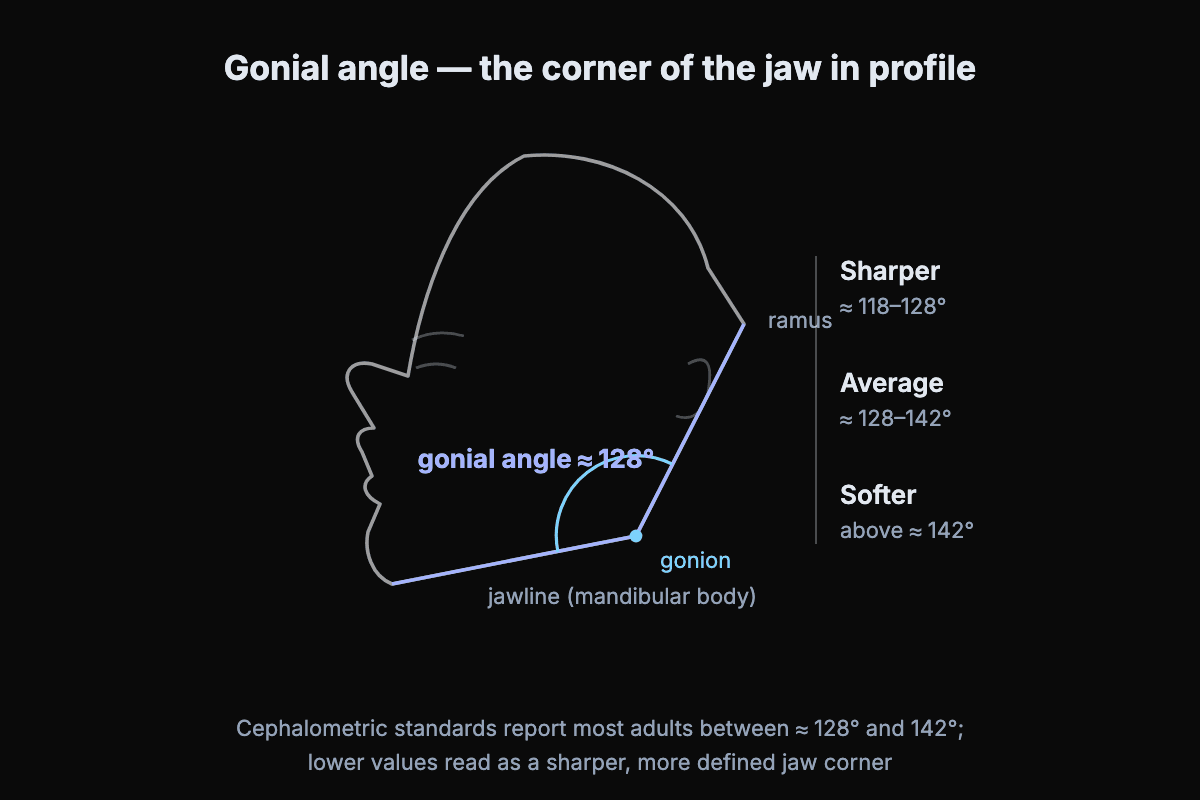
From the chin point, the scan reads the slope of the jaw line up to the mid-jaw landmark on each side and compares the two. The gonial angle — the "corner" of the jaw, where the vertical ramus meets the horizontal body of the mandible — needs a side view, so it is not computed from a front photo.
Jaw shape scoring
Jaw shape is scored from the same landmarks as ratios: jaw taper (jaw width at mid-jaw against cheekbone width) and chin proportion. Those are the jaw readings the full report ranks.
Where it sits
Each reading is placed against the distribution of real scans, so you see the band you read in rather than an isolated number. The gonial angle itself stays unprinted — a front photo cannot measure it, and a figure we cannot stand behind is worth less than the honest limit.
Photo angle vs clinical gonial angle
One honest caveat: a front-facing photo cannot see bone, so the angle the scan reads is not the clinical gonial angle from a cephalometric X-ray. From the 68 landmarks, the scan compares the jaw-line slope on the left and right sides, from the chin point to the mid-jaw landmark, and shows where that reading sits among RealSmile scanners. Because it compares the two sides, a symmetric jaw on a level head reads the same whatever its shape, and a head tilt moves it degree for degree, so the full report lists it without a score. What the report does score for jaw shape is jaw taper: jaw width at mid-jaw divided by cheekbone width (male band 0.72–0.85, female 0.62–0.75), alongside chin proportion. The 128–142° range you see in orthodontic literature is the X-ray measure of the gonial angle — useful context, and a side-view measurement a front photo cannot give you.
Research on jawline and attractiveness
The jawline is one of the most studied features in facial aesthetics research, and most of that work measures the gonial angle on a side-view X-ray or profile photo rather than a front selfie. That matters for anyone reading a jaw score: the clinical numbers and a front-photo reading are not the same measurement.
Cross-cultural research is less settled than the looksmax framing suggests. Scott, Penton-Voak and colleagues tested 12 populations with very different levels of economic development and found preferences for exaggerated sex-typical faces, a more masculine face shape in men included, only in the highly developed, urbanized ones (PNAS, 2014).
What changes a jaw in a photo is mostly body fat and head posture, not the bone. That is the honest limit on the mastic gum approach: in a 2024 randomised trial, adults who chewed gum three times a day for six months gained bite force, but masseter thickness and mandibular shape did not change (Jung et al., Journal of Oral Rehabilitation).
Side view
Needed to measure the true gonial angle; a front photo reads the jaw-line slope
128–142°
Typical adult gonial angle on a cephalometric X-ray (Proffit, 2018)
6 months
Of daily gum chewing in a randomised trial: no change in masseter thickness or jaw shape (Jung et al., 2024)
What our data shows
Our scanner has processed 35,000+ faces, and jawline is one of the most requested single metrics. The clinical reference ranges come from published cephalometric literature: the average adult gonial angle is about 135°, most adults measure 128–142° (Proffit, 2018), and the orthodontic ideal band is 120–135°. Each metric score places your measurement against the first scans of about 2,100 RealSmile users, so 50 is the median scanner.
Two published findings matter most for photo tests: forward head posture alone can add 3–8° to the apparent angle, and body fat, posture, and masseter work combined can shift the apparent angle by 3–12° without any change to the bone (Arnett & Gunson, 2004). Jaw width relative to cheekbone width also drives the classification in the face shape test, and jaw angle is one of the five bands scored in the masculinity test.
How to improve your jawline score
#1Reduce body fat (most impactful)
Facial fat sits directly over the jawline, masking bone structure. Dropping from 20% to 13-14% body fat reveals jawline definition that was always there. You cannot spot-reduce facial fat — it comes off as overall body fat decreases. 300-500 calorie deficit with high protein intake (0.8g/lb) and resistance training to preserve muscle.
#2Mastic gum (masseter training)
Mastic gum is much firmer than regular gum, and chewing it works the masseter, the muscle over the back corner of the jaw. Alternate sides every 10 minutes; jaw muscle fatigue is the training stimulus. Expect a stronger bite before any visible change: in a six-month randomised trial with ordinary gum, masseter thickness and jaw shape did not change.
#3Posture correction
Forward head posture compresses the neck and pushes the chin forward, softening the jaw profile. Chin tucks (30 reps, 3x daily) and wall angels (10 reps, 2x daily) correct this within weeks. The improvement is partly postural and partly real — better posture also holds the head in a more flattering position for photos.
#4Beard line optimization
A clean shave below the jawline (everything below the jaw border) creates high contrast that makes the jaw edge read as sharper. Stubble or beard along the jaw adds shadow that enhances definition further. This doesn't change your actual jaw angle but significantly changes how it reads in photos and in person.
Free · Instant · No signup
Get your jawline score now
AI reads your jaw silhouette from a single selfie and scores how defined it is, with a personalized improvement plan. It does not print a gonial angle in degrees — a front photo cannot measure that honestly. Free scan, full report for $14.99.
Test My Jawline →Frequently asked questions
How is jawline measured by AI?
AI detects the mandibular boundary landmarks and reads the slope of your jaw silhouette. It is reported as a definition band, not degrees: the gonial angle proper is the angle where the vertical ramus meets the horizontal mandibular body, and measuring it requires a side view.
What is a good jawline score?
120-130° is elite (top ~10%). 131-140° is above average. 141-148° is average for most people. Above 149° scores below average. Most people improve significantly through fat loss alone.
Can you improve your jawline naturally?
The way it reads, yes; the bone, no. Body fat reduction reveals underlying jaw definition (most impactful), and posture correction sharpens the jaw profile. Mastic gum works the masseter, but in a six-month randomised trial of daily gum chewing, masseter thickness and jaw shape did not change.
Does jawline change with age?
Yes — the gonial angle tends to widen with age through bone remodeling and dental changes, and tooth loss accelerates it. Significant fat gain accelerates perceived jaw softening.
Is a sharp jawline attractive?
It depends on who is looking. Across 12 populations, preferences for exaggerated sex-typical faces, a more masculine face shape in men included, appeared only in highly developed, urbanized ones (Scott, Penton-Voak et al., PNAS 2014).
Does chewing gum sharpen your jawline?
It can change how your jaw reads, within limits. Chewing trains the masseter — the muscle over the back corner of the jaw — and a fuller masseter can widen and define that area. The published framing matters, though: body fat, posture, and masseter work combined shift the apparent jaw angle by roughly 3–12° (Arnett & Gunson, 2004); none of it changes the underlying bone. Gum is the smallest of those three levers — fat loss usually moves the read far more than chewing does.
Is jawline mostly genetic?
The bone is; the read is not. Mandible shape and the true gonial angle are set by genetics and growth, and in adults they only change through surgery. What a photo shows is bone plus everything over it: cephalometric standards put most adults at a 128–142° gonial angle (Proffit, 2018), yet forward head posture alone can add 3–8° to the apparent angle, and soft-tissue factors can shift the apparent read by 3–12° in total (Arnett & Gunson, 2004). Two people with identical bone can photograph very differently.
Is this a gonial angle calculator?
Partly, and the limit matters: we read your jaw silhouette from 68 landmarks on a front photo, but we do not output a gonial angle in degrees. One caveat: the clinical gonial angle is measured from a cephalometric X-ray, so a photo-based calculator reports the apparent angle — bone plus the soft tissue over it.
What is the difference between jawline angle and gonial angle?
The gonial angle is a clinical measurement taken from a cephalometric X-ray at the gonion — where the vertical ramus meets the body of the jaw — and most adults measure 128–142° (Proffit, 2018). A front photo cannot see that angle, so this scan does not estimate it. Its jawline angle reading compares the jaw-line slope on the left and right sides, from the chin point to the mid-jaw landmark, so it reads left-right balance and moves with head tilt: shoot with your head level. Jaw shape itself is scored through jaw taper and chin proportion.
What is a good jaw-to-cheek width ratio?
Jaw taper compares jaw width at mid-jaw with cheekbone width. The scan gives full credit at 0.72–0.85 for male scoring and 0.62–0.75 for female — a lower ratio means the face narrows more from cheekbones to jaw (a V-shaped taper), while a ratio near 1.0 reads square. These are scoring conventions calibrated to the landmark scan, not clinical thresholds.
8-metric suite
Your complete looksmax scorecard
One AI scan measures all 8 metrics from a single selfie. You've explored one — get the full picture.