What face shape do you have? Oval, round, square or heart
Upload a photo and our AI measures your face width, cheekbone width, jaw width, and face length to identify your exact face shape — oval, round, square, heart, oblong, or diamond.
100% free, and private by default. On desktop the analysis runs in your browser; on mobile your photo is processed in memory and deleted instantly. Nothing is kept unless you choose to save it.
17 metrics · NIH-cited landmarks · Processed in memory, deleted right after analysis
Use a front-facing photo, chin level, hair off the temples. Processed in memory and deleted right after analysis.
10 seconds · No signup · Free forever · full face scan · written audit — $19.99
Sample result preview
IllustrativeYour detected shape
Oval 87%
Length:Width 1.48 · cheek > forehead > jaw · runner-up: Heart
Forehead
0.94× cheek
Cheekbone
widest point
Jaw
0.83× cheek
Sample numbers — your actual result is computed from your photo. Run the test above.
Your results expire after this session — save or screenshot your report
Your Face Shape
Upload a front-facing photo to get your score
Reading is one thing — knowing yours is another
Measure YOUR Face Shape
Upload one selfie and the scanner measures your face shape plus 16 more — symmetry, jawline, golden ratio — in about 30 seconds. Free, no signup.
Scan my face free →Upload a selfie
Get scored, free
Unlock the report
How the face shape test works
Four measurements determine your face shape. AI extracts all of them from a single photo.
Forehead Width
Measured at the widest point, roughly at the hairline — about 1/3 of the way down from the top.
Cheekbone Width
The widest part of your face, measured across the cheekbones just below the eyes.
Jaw Width
Measured at the widest part of the jaw, roughly one inch above the chin.
Face Length
Top of the forehead to the bottom of the chin. The length-to-width ratio determines oval vs round vs oblong.
The 6 face shapes — which one are you?
Each shape has distinct characteristics, flattering hairstyles, and ideal frame shapes for glasses.
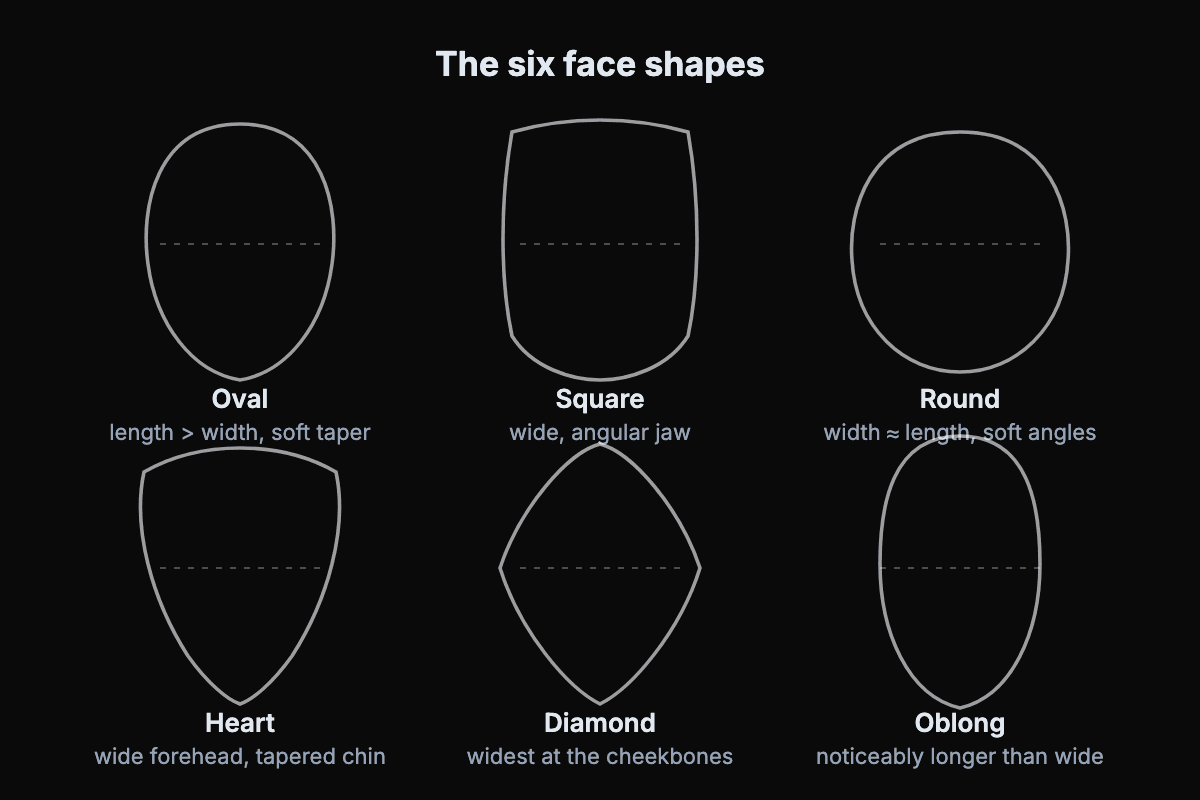
Compare all 6 silhouettes at a glance
Oval
Round
Square
Heart
Oblong
Diamond
Schematic silhouettes — proportions only, not real photos.
Oval
Length:Width ≈ 1.5:1 · cheek > forehead > jaw
Slightly wider at the cheekbones with a gently tapering forehead and chin. The most balanced face shape — almost any hairstyle works.
Hair: Almost any style works. Long layers, bobs, curtain bangs.
Glasses: Any frame shape flatters an oval face.
e.g. George Clooney, Bella Hadid
Round
Length:Width ≈ 1.0:1 · soft curves, no hard angles
Roughly equal width and length, with soft, curved lines and full cheeks. Adding height and angles creates the illusion of length.
Hair: Add height with volume at the crown. Avoid blunt cuts at chin level.
Glasses: Angular or rectangular frames. Avoid round frames.
e.g. Selena Gomez, Leonardo DiCaprio
Square
Length:Width ≈ 1.0:1 · forehead ≈ jaw, sharp angles
Strong, angular jawline with roughly equal width at forehead, cheeks, and jaw. A bold, defined look.
Hair: Soft waves and layers to soften the jaw. Side-swept styles.
Glasses: Round or oval frames to soften angles.
e.g. Angelina Jolie, Brad Pitt
Heart
Forehead > cheek > jaw · chin point sharp
Wider forehead tapering to a narrow, pointed chin. Also called inverted triangle. High cheekbones are common.
Hair: Volume at the jaw — lobs, chin-length bobs. Avoid heavy top volume.
Glasses: Bottom-heavy frames or rimless styles.
e.g. Scarlett Johansson, Ryan Gosling
Oblong
Length:Width ≥ 1.6:1 · forehead ≈ cheek ≈ jaw
Longer than wide with straight sides and minimal curves. Adding width creates a more balanced appearance.
Hair: Side parts, bangs, and width-adding layers. Avoid long, straight styles.
Glasses: Deep frames with decorative temples to add width.
e.g. Adam Driver, Liv Tyler
Diamond
Cheek > forehead, cheek > jaw · double-taper
Widest at the cheekbones, narrowing at both forehead and chin. High, prominent cheekbones are the defining feature.
Hair: Add width at forehead and jaw with bangs or chin-length layers.
Glasses: Oval or cat-eye frames to balance cheekbones.
e.g. Rihanna, Johnny Depp
Shape profiles in depth — traits, score tendencies, and styling
Once the test names your shape, this is the follow-up reading: what geometrically defines it, which of our 17 scoring metrics it tends to pull up or down, and the styling levers that work with the proportions instead of against them. Shape is a category rather than a score — if you also want a number, the free face rating test scores your photo out of 10.
Heart face shape
The forehead is the widest point of the face — the trait that separates heart from diamond, where the cheekbones are widest — tapering through prominent cheekbones to a narrow, often pointed chin. A widow's peak is common but not required; the defining trait is the forehead-to-chin taper, not the hairline. In facial-perception research, a wider forehead relative to the lower face is a stable correlate of perceived youthfulness.
On our 17-metric engine, heart faces tend to score higher on forehead proportion and chin taper, and lower on jawline definition — by construction of the geometry, not as a flaw. Most score lifts come from angle work rather than features: camera at eye height or slightly higher, and a chin-forward, jaw-out pose that keeps a low camera angle from softening the chin read.
Styling: volume at the jaw — chin-length bobs, lobs, curtain bangs — balances the inverted-triangle silhouette; heavy top volume adds to it. Bottom-heavy or rimless glasses frames do the same rebalancing. Makeup, if wanted: blush placed mid-cheek rather than swept high adds visual weight to the lower face; a flatter brow shortens the visual height of a wide forehead.
Oblong face shape
Sometimes called rectangle: face length is meaningfully greater than width — typically a length-to-width ratio above 1.6 — with forehead, cheekbones, and jaw at similar widths. It shares the parallel-sides signature with square but stretched vertically, with a midface that runs longer than the population average and often a high hairline that adds to the perceived length.
Facial-thirds balance tends to score lower for oblong faces because the middle third runs long, while vertical symmetry tends to score above the population mean — small midline deviations are less visually amplified on a longer axis. Framing fixes carry most audit lifts: tighter shoulder-up crops and directional side light, not feature work.
Styling: hairstyle and beard framing matter more here than on any other geometry. Side volume with minimal top height balances the vertical bias; a full, wide beard adds width to the lower third. Deep rectangular glasses frames with decorative temples add width. Blush swept straight across toward the ears — not up toward the temples — widens the midface on camera.
Oval face shape
The geometric reference shape: face length roughly 1.5× the cheekbone width, forehead slightly wider than a softly tapered jaw, and cheekbones modestly the widest point. The jawline curves rather than angles — no hard corner at the gonion — and no single feature dominates the silhouette. Much attractiveness research uses oval as the implicit baseline proportion, which is partly why it tolerates almost any photo angle.
In our scoring distribution, oval faces rarely fail any single metric badly but also rarely spike on one: facial-thirds balance and midface ratio tend higher, while jawline definition tends lower simply because curved jaw corners produce less hard-edge contrast. Low oval scores almost always trace to photo quality, lighting, or expression rather than geometry — a retake usually moves the number more than anything else.
Styling: almost any cut works — oval is the shape barbers use as the reference when adapting styles for other shapes — and any glasses frame flatters it. Contour is optional on this geometry; there is nothing to rebalance, so heavy sculpting tends to read as makeup rather than face.
Round face shape
Face length approximately equals face width, with forehead, cheekbones, and jawline all at roughly the same width, full cheeks, and a rounded chin — curves everywhere, no hard angles. Apparent fullness is partly body-composition-dependent and shifts with weight. Published facial-perception research consistently links soft, rounded features to higher perceived trustworthiness and approachability.
Round faces tend to score higher on width-to-height ratio and on the trustworthiness trait dimension, and lower on jawline definition — curved corners by construction. The geometry is unusually sensitive to flat overhead light, which removes what little shadow structure it has; directional side light at 30–45° is the single most reliable score fix, ahead of any styling change.
Styling: height and volume at the crown add the perceived length the geometry doesn't provide; blunt chin-level cuts emphasize width. Angular or rectangular glasses frames counter the curves. The classic under-cheekbone contour earns its reputation on this shape — it adds the angle the camera doesn't otherwise see — while blush square on the apples leans into the warm, youthful read on purpose.
Square face shape
Forehead, cheekbones, and jaw share roughly the same width with minimal taper, a hard-angled gonial corner, and a broad, squared chin — often paired with a straight hairline that adds to the boxed silhouette. Published research links this width-uniform, angular geometry to high perceived dominance and competence.
Square faces produce the highest jawline-definition scores in our distribution — the shape's structural strength — and tend high on width-to-height ratio, while cheekbone protrusion and midface ratio score lower because nothing protrudes relative to anything else. The same geometry that reads authoritative in professional headshots can read cold on dating photos when the expression is neutral; a genuine smile is the highest-leverage fix, converting the dominance signal into warmth without losing the structure.
Styling: softness and texture on top — waves, layers, side-swept styles — balance the angular jaw; round or oval glasses frames do the same. Hard directional sidelight photographs this shape as sculpted; overly harsh light tips it into severity. Rounded blush placement softens the straight-line geometry, while a flat brow amplifies it — useful for authority-coded headshots, heavier than most people want on a dating profile.
Get your exact result
Find your face shape — then measure 17 facial metrics
The Looksmaxxing Test measures canthal tilt, FWHR, jaw taper, facial symmetry and 13 more metrics from one upload. Your Face Score and your strongest metric are free.
Get My Full Analysis Free →Free · 10 seconds · No signup · Premium deep-dive $14.99
How face shape is determined from your photo
The AI runs a 68-point landmark detector and locates four anchor pairs: the temporal points (forehead width), the zygion (cheekbone width), the gonion (jaw width), and the trichion-to-menton line (face length, hairline to chin). Three ratios are then computed — face length divided by cheekbone width, forehead width divided by jaw width, and the rate at which width tapers from cheekbones to chin.
Those three numbers are enough to deterministically place a face into one of the six standard categories used by craniofacial anthropometry papers and by the cosmetology industry. An oval face has a length-to-width ratio above 1.5 with smooth tapering. A round face has a ratio close to 1.0 with no clear tapering. A square face has a ratio close to 1.0 with parallel forehead and jaw widths. A heart face has wider forehead than jaw with a sharp chin point. Oblong faces share the parallel forehead-jaw signature with square but have a length-to-width ratio above 1.6. Diamond faces have cheekbones wider than both forehead and jaw with angular tapering at both ends.
Because the same landmarks generate the ratios deterministically, the test result is consistent across uploads of the same person — variation only appears when head pose, hair coverage, or lens distortion change which landmarks are visible. Front-facing, neutral expression, hair pulled back gives the cleanest result.
What our data shows
Our scanner has processed 35,000+ faces, but your shape category is not graded against that corpus. The category boundaries come from published anthropometric literature instead: in one published sample the mean facial width-to-height ratio was 1.86 for men and 1.80 for women (Carré & McCormick, 2008), and across studies observers judge wider faces as more dominant (Geniole et al., 2015), a theme we score separately on the masculinity test. The jaw-taper ratio that separates square from heart and diamond is the same measurement behind the jawline angle test, and the vertical proportions your shape interacts with are measured on the facial thirds test.
What your face shape result actually means
Face shape is a description of bone-structure proportions, not a verdict on attractiveness. Every shape has been called "the most attractive" in a published paper somewhere — oval gets the most votes because of its balance, but heart faces dominate fashion editorials, square jaws dominate leading-man casting, and diamond faces dominate high-fashion runways. The shape itself is neutral; what matters is how you style around it.
Use the result for two practical decisions. First, hairstyle and beard: every shape has cuts that exaggerate its dominant feature and cuts that visually rebalance it. Round faces gain definition with crown volume; square jaws soften with side-swept length; heart faces look proportional with chin-length volume. Second, eyewear and accessories: glasses frames either echo your dominant facial line (reinforcing it) or counter it (rebalancing). Both can be the right call depending on what you want to project.
The result is not a fixed label. Body fat, hairline, beard density, and aging all shift apparent face shape over time. Re-running the test every six months tracks real changes — and after significant fat loss or gain, the category often changes outright as the buccal fat layer changes.
Three myths about face shape
Myth 1
"There is one universally most attractive face shape."
Cross-cultural research finds modest preferences for oval and balanced proportions, but the effect is weaker than the effect of expression, grooming, and skin condition. People rate genuinely smiling oblong faces higher than dour oval ones in every replication.
Myth 2
"Mewing will change your face shape as an adult."
Tongue posture exercises can produce small soft-tissue changes and modest postural improvement, but they do not remodel the maxilla or mandible in adults whose growth plates have closed. Real bone-structure changes in adulthood require orthognathic surgery or jaw filler. Reducing body fat is the single biggest lever for changing apparent face shape without medical intervention.
Myth 3
"You only have one face shape."
At borderline ratios, two categories can fit. Many faces sit between oval and oblong, or between square and round. The AI returns the closest single match for clarity, but the runner-up shape often gives equally valid styling guidance.
Verify your shape with a ruler — 3-question decision tree
Don't want to upload a photo? Stand in front of a mirror with a ruler or measuring tape. Take three measurements, then walk the tree. You'll land on the same shape the AI returns — or surface a borderline case worth re-testing.
Measure: L = hairline to chin · W = widest point across cheekbones · F = forehead width at hairline · J = jaw width an inch above the chin.
Length-to-width ratio
Divide L by W. Is the ratio above 1.5?
Yes (L/W > 1.5)
Long face. Skip to Node 2A — you're Oval or Oblong.
No (L/W ≤ 1.5)
Compact face. Skip to Node 2B — you're Round, Square, Heart, or Diamond.
Sides taper or stay parallel?
Compare F and J. Are they within 5mm of each other?
Cheekbone dominance
Is W clearly greater than both F and J?
Forehead-to-jaw signature
Compare F to J. Which is wider?
F > J
Heart — wide forehead, sharp chin point.
F ≈ J (parallel)
Square if jaw feels angular, Round if jaw feels soft.
J > F
Re-measure — this is rare and usually a hairline-coverage artifact.
Borderline ratios (L/W between 1.45 and 1.55, or |F−J| between 4 and 6mm) are where the AI and the ruler can disagree by one category. Re-run with hair pulled back if you land on a boundary.
Research behind face-shape attractiveness
Symons (1995)
Beauty is in the adaptations of the beholder — in Sexual Nature, Sexual Culture, University of Chicago Press
Argued that perceptions of facial attractiveness are partly the output of evolved preferences for cues of fertility and health, and that proportional balance — including features captured by face-shape categories — is one such cue. Foundational for treating face shape as a meaningful variable rather than pure cultural noise.
Jones et al. (2001)
Facial symmetry and judgements of apparent health — Evolution and Human Behavior, 22(6), 417–429
Found that facial shape symmetry — the lateral balance evaluated when categorizing face shape — independently predicts ratings of perceived health, even when image quality and skin condition are controlled. Reinforces that the proportions captured in face-shape analysis carry signal beyond pure aesthetic taste.
Farkas (1994)
Anthropometry of the Head and Face — Raven Press, 2nd ed.
The standard reference for facial anthropometric measurement. The landmark definitions used to compute forehead width, cheekbone width, jaw width, and face length in this AI tool are derived directly from Farkas's anatomical conventions, which remain the basis for both clinical craniofacial work and modern landmark-detection models.
Honest limits of this test
- Hair coverage of the temples or jawline biases the result. Pull hair back for the cleanest scan; long fringes systematically push faces toward "oblong."
- Three-quarter or tilted angles distort the width-to-length ratio. Use a front-facing photo with the chin level.
- Beard density visually thickens the jaw and can shift a heart-shaped result toward square. Re-test clean-shaven if you want the bone-structure baseline.
- Wide-angle phone lenses (most front cameras) inflate apparent face width. Stand at arm's length, not closer.
- The six-category system is a simplification. Real faces lie on a continuum; treat the result as a guide, not a fixed identity.
Shape-to-lever map — what to actually change once you know
Knowing your face shape is the input. The output is a different intervention stack per shape — hairline, beard, jaw posture, and photo angle each carry different weight depending on whether your face is wider than long, longer than wide, or balanced. The map below converts the six shape categories into the three or four levers most likely to move your perceived score, ranked by effort-to-impact.
Already balanced. Levers are mostly photo-side: angle, lighting, smile honesty. Avoid heavy fringes that hide forehead.
Top lever is jaw definition (mewing, body-fat, posture). Hair: add height. Beard: vertical (goatee/extended chin) over full.
Strong jaw is the asset. Soften top: longer textured hair, no buzz. Beard: short and even, never fuller than your hair.
Forehead reads wide. Add hair volume on sides not on top. Beard: build it to widen jaw and balance the cheekbone-to-chin taper.
Length is the read. Hair: side volume, never tall. Beard: full and wide, not pointed. Glasses: rectangular wide frames.
Cheekbones lead. Hair: forehead-covering fringe to shorten the face length. Beard: wider at jaw to balance the cheekbone width.
The lever is not "be a different shape." It is "stop fighting the shape you have." Most failure modes (round face with tall pomp, oblong with no facial hair, heart with flat top hair) come from copying styles that worked on a different shape.
A fast way to find styles that already work for your proportions: the free who do I look like test matches your geometry to a celebrity archetype with a similar shape — their stylists solved your face shape years ago.
Face shape FAQ
How do I find out my face shape?
The most accurate way is a front-facing photo analyzed by AI. The tool measures forehead width, cheekbone width, jaw width, and face length — the four numbers that determine your shape. Manual methods with a tape measure work too, but are less precise.
What is the most attractive face shape?
Research consistently shows oval faces score highest on average due to balanced proportions. But strong square and heart-shaped faces are also rated highly — especially combined with strong, defined features. Face shape is one of many attractiveness factors.
What is the rarest face shape?
Diamond face shapes are the rarest — they require very specific proportions with wide cheekbones and a narrower forehead and jaw. Oblong faces are also uncommon. Round and oval are the most common.
What ratios determine face shape?
Three ratios drive the classification: face length divided by cheekbone width (oval ≈ 1.5:1, round ≈ 1.0:1, oblong ≥ 1.6:1), jaw width divided by cheekbone width (the taper that separates heart and diamond from square), and forehead width compared to jaw width (parallel widths point to square or oblong, a dominant forehead points to heart). All three come from the same 68-point landmark scan.
What is the difference between an oval and an oblong face?
Both are longer than they are wide — the separator is tapering. An oval face narrows smoothly from the cheekbones toward both the forehead and the chin, while an oblong face keeps the forehead, cheekbones, and jaw at nearly the same width, giving straight, parallel sides. Oblong faces also tend to run longer, with a length-to-width ratio of 1.6 or above versus roughly 1.5 for oval.
Does a beard change my face shape result?
Yes — beard density visually widens and lengthens the lower face, so a heart-shaped face can read as square and a round face as oval depending on the trim. The landmark scan measures what is visible in the photo, so test clean-shaven or with a tight trim if you want your bone-structure baseline, then use the beard deliberately as a styling lever for your shape.
Can my face shape change?
Subtly, yes. Weight changes, aging, and changes in facial fat distribution all affect apparent face shape. Bone structure is largely fixed after early adulthood, but the soft tissue layer significantly impacts how angular or round your face looks.
What hairstyle suits my face shape?
Each face shape has flattering hairstyle principles: oval faces suit almost any style; round faces benefit from height and volume at the crown; square faces look good with soft layers; heart faces suit jaw-length volume; oblong faces benefit from width-adding cuts; diamond faces look great with bangs or chin-length styles.
How accurate is AI face shape detection vs. measuring with a tape?
Tape-and-mirror measurement has roughly 5–10% measurement error from operator inconsistency (where exactly is the cheekbone widest?). AI landmark detection on a clean front-facing photo is comparable or better — typically within 2–3% of expert clinical measurements. The biggest accuracy hit comes from photo angle, not the AI itself.
8-metric suite
Your complete looksmax scorecard
One AI scan measures all 8 metrics from a single selfie. You've explored one — get the full picture.
Premium Dating Photo Audit · Delivered in 1–2 minutes
Get your dating photos audited.
Rank 2 to 6 photos free (your first 3 are scored free) and see which one should lead. Then unlock the full written audit on up to 10 photos — each photo ranked with its strongest and weakest metrics, what to delete, three reshoot fixes, a 20-dater AI voter panel + downloadable PDF — for $19.99.
✓ 1–2 min delivery · ✓ 17 metrics measured · ✓ Lead-photo verdict · ✓ Stripe secured