Do you have hunter eyes? Canthal tilt, eyelids, brow position
Our AI measures your canthal tilt, eyelid exposure, and brow position — the three markers that determine hunter eyes vs. prey eyes. Check yours free below from a single photo.
Free, and private by default. On desktop the analysis runs in your browser; on mobile your photo is processed in memory and deleted instantly — nothing is kept unless you choose to save it.
17 metrics · NIH-cited landmarks · Processed in memory, deleted unless you save it
10 seconds · No signup · Free forever
Your results expire after this session — save or screenshot your report
Your Hunter Eyes Score
Upload a front-facing photo to get your score
Measure your hunter eyes in 60 seconds
Our 60-second hunter eyes explainer, word for word — the honest version of the answer:
What are hunter eyes? And can you actually get them?
It's a read on your eye shape. A compact, slightly upswept eye line, with not much upper eyelid showing.
That's a commonly cited look. It's not a law, and rounder eyes are not a flaw.
Squint slightly and the same eyes read more hunter. A lot of this is expression, not anatomy.
So is it fixable? Partly. The shape is set by bone and lids. Sleep, puffiness, and body fat move how it looks.
De-puffing and a relaxed, level gaze change how it reads in a photo. Not your anatomy. And that's fine.
See how yours reads. One of seventeen measurements, free, at realsmile.online.
5 photo-side levers that shift the hunter-eye read
These won't change your underlying anatomy, but they reliably shift how your eye area photographs. Useful before re-uploading for a re-score.
Eyebrow shape
Action: Trim brow tail slightly lower, reduce arch.
What changes: Brow line sits closer to upper eyelid → hunter-eye read amplifies.
Hairstyle
Action: Side-swept fringe casting a soft shadow on the upper eyelid.
What changes: Visible lid hooding increases without changing actual lid anatomy.
Photo lighting
Action: Top-down or 30°-overhead light source — avoid flash directly on the brow.
What changes: Brow ridge casts a shadow → ridge prominence reads stronger.
Eye expression
Action: Slight squint or "side-eye" (corrugator engagement) — not a smile.
What changes: Palpebral fissure narrows → almond shape and tilt read sharper.
Lower body fat
Action: Reduce upper-lid puffiness via baseline body composition.
What changes: Less subcutaneous lid fat → clearer almond eye shape (general well-being lever; not a quick fix).
What this section is NOT
We do not recommend surgical procedures, eye drops, mewing-for-eyes, or other unproven looksmaxxing claims. The 5 levers above are styling and photographic-read levers — they shift how your eyes photograph without medical claims. Hunter-eye perception is a Tier-3 community-validated metric (see our evidence-tier explainer at /tools); the literature on specific "hunter eyes = attractiveness" degree-by-degree gradients is thin. Use Tier-1 results (symmetry, FWHR) as your anchor.
Lever effect varies per face. Re-upload after one change at a time so you can attribute the score shift to a specific lever.
Before you measure: when this score should NOT matter
A canthal-tilt number is meaningless if the act of measuring is hurting you. Read this first.
Mental-health red flags
If any of these describe you, pause
- Checking your eyes/face in mirrors more than 30 minutes/day
- Avoiding social events, work, or relationships because of perceived eye-shape "flaws"
- Strong distress, panic, or shame triggered by photos of yourself
- Comparing your eyes to specific celebrities or community members compulsively
- Considering surgery primarily to fix a feature most people don't notice
If 2+ of these resonate, the issue isn't your canthal tilt — it's worth talking to a primary-care physician or a BDD-trained therapist. Body dysmorphic disorder is treatable.
Surgical risk reality check (canthoplasty / canthopexy)
Cosmetic-eye surgery is real surgery
- Lower-lid retraction — exposed sclera, watery eye, often requires revision
- Ectropion (lid pulling outward) — chronic dry eye, irritation
- Scar asymmetry between eyes — may worsen the very asymmetry you tried to fix
- Revision-surgery risk — each revision is harder than the first
Risks compound across revisions. A board-certified oculoplastic surgeon will discuss these honestly — if a clinic minimizes them, leave.
If you need to talk to someone
Search these — no judgment, no cost to ask
- BDD Foundation (UK / global) — body dysmorphic disorder education + therapist directory
- NEDA — National Eating Disorders Association — looksmaxxing overlap with disordered eating is significant
- Your primary-care physician — first stop for a referral, no judgment
This score is a tool. Tools aren't worth your wellbeing.
Hunter eyes vs. prey eyes — the difference
Three measurable traits separate hunter eyes from prey eyes. The looksmaxxing community uses these as a key attractiveness metric.
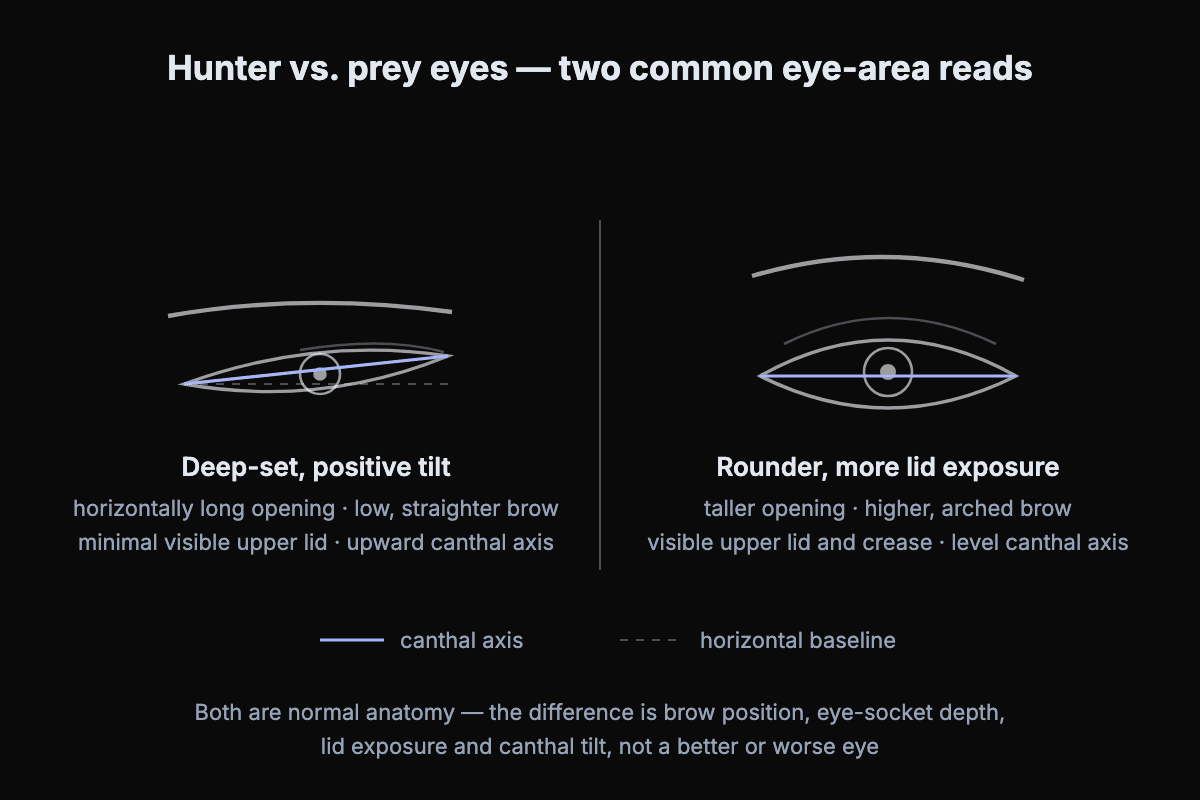
Hunter Eyes
Prey Eyes
The 3 markers the AI measures
Your hunter eyes score is a composite of these three measurable traits, each extracted from 68 facial landmarks.
Canthal Tilt
The angle between the medial canthus (inner corner) and lateral canthus (outer corner) of each eye. Measured in degrees. Positive values = hunter eyes. This is the single strongest marker.
Eyelid Exposure
How much of the iris is covered by the upper and lower lids. Lower exposure means the iris takes up more of the visible eye area — a key marker of hooded, hunter-style eyes.
Brow Ridge Position
The vertical distance between the brow and the upper eyelid. A shorter distance (closer brow to lid) indicates a more prominent brow ridge and deeper-set eyes — the characteristic hunter eye look.
What our data shows
Our scanner has processed 35,000+ faces, and the eye area is consistently among the most-checked regions. The reference bands come from published anthropometric literature, and canthal tilt, one input to the index, can be scored on its own with the canthal tilt test. Each metric score places your measurement against the first scans of about 2,100 RealSmile users, so 50 is the median scanner. There is no peer-reviewed "hunter eye" dataset; the term is a community label for a combination of measurable traits, which is why the scan reports the underlying geometry instead of a single verdict.
How the scan computes your Hunter Eye Index
The test runs a 68-point landmark scan — in your browser on desktop, and on mobile the photo is processed in memory and deleted instantly; nothing is kept unless you choose to save it. For each eye it takes the width from the outer to the inner corner and divides it by the average vertical lid opening, measured at two upper-to-lower lid point pairs; the two eyes are then averaged. Narrower, more elongated eyes produce a higher ratio, and the tool gives full credit in the 2.8–3.5 width-to-height band. Two supporting measurements shape the read: eye spacing — the distance between the inner corners divided by average eye width, ideal roughly 1:1 (0.9–1.1) — and brow-eye proximity, where a brow sitting about 0.03–0.07 of face height above the eye reads as a more prominent brow ridge in male scoring. Brow-eye proximity is also one of the bands scored in the masculinity test.
What research says about canthal tilt and attractiveness
Several peer-reviewed studies have examined the relationship between canthal tilt and attractiveness ratings. A 2014 study in PLOS ONE found that upward-tilted eye corners were consistently rated as more attractive across diverse rater populations. The researchers proposed this is because positive canthal tilt is associated with youth — the outer corners naturally drop slightly with age as soft tissue loses elasticity.
Separately, research on eye shape and dominance perception found that more hooded, deeper-set eyes are associated with perceived dominance and intensity — traits that correlate with attractiveness in male faces in particular. This may partly explain why hunter eyes became a focal point in looksmaxxing communities.
Important caveat: attractiveness research shows that canthal tilt matters, but it's one of many factors. Expression quality, symmetry, and grooming have larger effect sizes in most studies. Having neutral or even slightly negative canthal tilt does not make someone unattractive — the world's most successful models include people across the full canthal tilt spectrum.
Can you develop hunter eyes?
Mewing (tongue posture)
Possibly, in young peopleProper tongue posture (tongue on the roof of the mouth, not the floor) is theorized to forward-project the maxilla over years, which can subtly affect midface structure. In skeletally mature adults (mid-20s+), structural changes from mewing are minimal. In younger people still developing, the effect may be real but slow.
Reducing body fat
Yes — meaningful effectLower body fat percentage reduces facial fat deposits around the eyes and brow, making the brow ridge appear more prominent and the eye area more defined. This is one of the most impactful and achievable changes — many people see a dramatic shift in their eye area with 5-10% body fat reduction.
Sleep & hydration
Yes — significant day-to-day impactPoor sleep causes eyelid puffiness and drooping, which can temporarily worsen canthal tilt appearance and create more scleral show below the eye. Consistent 7-9 hours of sleep and good hydration meaningfully improve how hunter-like your eyes look in photos.
Bone smashing
No — not legitimateBone smashing (intentionally striking the face to stimulate bone remodeling) is a dangerous internet myth with no scientific basis. Adult bone remodeling from trauma heals irregularly and can cause permanent damage. Do not attempt this.
Canthopexy / canthoplasty surgery
Yes — surgical optionCanthopexy tightens the lateral canthus to raise drooping outer eye corners. Canthoplasty is a more extensive procedure that repositions the lateral canthal tendon. Both are legitimate procedures performed by oculoplastic surgeons, with real risks including dry eye, asymmetry, and revision requirements. Consult a board-certified specialist.
Celebrities commonly cited as having hunter eyes
Henry Cavill
Strong positive canthal tilt, deep-set hooded eyes
Jake Gyllenhaal
Narrow eye shape, well-defined brow ridge
Bradley Cooper
Slight positive tilt, compact eye opening
Angelina Jolie
Prominent canthal tilt, almond-shaped hooded eyes
Megan Fox
Deep-set eyes, positive tilt, full brow coverage
Timothée Chalamet
Elongated almond shape, subtle positive tilt
Do I have hunter eyes? 4 signs to check
You likely have hunter eyes if these markers line up. Check each one in a mirror or, faster, run the photo test above — it measures the underlying geometry for you instead of leaving you guessing.
- 1
Positive canthal tilt
The outer corner of each eye sits higher than the inner corner when you look straight ahead. The scan reports this angle in degrees; hunter eyes typically show +3° or more.
- 2
Hooded or deep-set upper lids
The brow bone partially covers the upper eyelid, so little lid skin shows — the low-upper-eyelid-exposure look. Hooding raises the width-to-height ratio the scan measures.
- 3
Minimal scleral show
Little to no white is visible below (or above) the iris when your eyes are relaxed. More visible white pushes the read toward rounder, more open "prey eyes."
- 4
A prominent brow ridge
The brow sits close over the eye — roughly 0.03–0.07 of face height in male scoring — which strengthens the hunter read; a high, arched brow works against it.
If three or four of these line up, your eyes almost certainly read as hunter eyes. The scan below scores each marker individually, so you get an objective read instead of a mirror guess.
Get your exact score
Test your hunter eyes + 16 more facial metrics
The Looksmaxxing Test measures canthal tilt, FWHR, jaw taper, facial symmetry and 13 more metrics. Your Face Score and your strongest metric are free; full report $14.99.
Test My Hunter Eyes Free →Free · 10 seconds · No signup · Premium deep-dive $14.99
Hunter eyes FAQ
Do I have hunter eyes?
You likely have hunter eyes if three markers line up: a positive canthal tilt (outer eye corners sit higher than the inner corners), low upper-eyelid exposure (a hooded or deep-set look under the brow), and minimal white showing below the iris. The quickest way to check is a photo test — this page measures your canthal tilt in degrees and your eyelid exposure from a single front-facing photo, so you get an objective read instead of guessing in the mirror.
What exactly are hunter eyes?
Hunter eyes describe a specific eye shape characterized by positive canthal tilt (outer corners higher than inner corners), minimal scleral show (less white visible), hooded eyelids, and an overall narrow, almond-like eye shape. The term originated in looksmaxxing communities contrasting this "predator" aesthetic with rounder "prey eyes."
How is canthal tilt measured?
Canthal tilt is the angle (in degrees) between an imaginary line connecting your medial canthus (inner corner) and lateral canthus (outer corner) and a perfectly horizontal line. Positive values mean the outer corner is higher; negative values mean the outer corner is lower. Most people have a tilt between -5° and +5°. Hunter eyes typically show +3° or more.
Are hunter eyes genetic?
Primarily yes. The bone structure of the orbit (eye socket), the position of the lateral canthal tendon, and the amount of periorbital fat are largely determined by genetics. However, body composition, sleep quality, and facial muscle tone all influence how hunter-like your eyes appear day-to-day.
Do women find hunter eyes attractive?
Research on female preference generally shows that positive canthal tilt and a more intense, deep-set eye appearance are rated as attractive in male faces. However, individual preferences vary significantly, and many women prefer warmer, more open eye shapes. Attractiveness is multifactorial — eyes are one signal among many.
What is a good hunter eye ratio?
The scan scores eye elongation as eye width divided by vertical lid opening, and gives full credit between 2.8 and 3.5. Below that band, eyes read rounder and more open; above it, they read very narrow. This ratio is a geometric description, not a published attractiveness threshold — no peer-reviewed study defines a "hunter eye ratio" — so treat the band as a scoring convention rather than a scientific cutoff.
Do hooded eyes count as hunter eyes?
Often, yes. Hooding reduces the visible vertical lid opening, which raises the width-to-height ratio the scan measures, so hooded eyes frequently land in the elongated band. But the hunter-eye read is a combination — canthal tilt, low scleral show, and brow position all contribute — so hooded eyes with a neutral or negative tilt usually read as "hooded" rather than "hunter."
Does brow position affect hunter eyes?
Yes. The scan measures brow-eye proximity — the gap between the brow and the eye as a fraction of face height. In male scoring, a gap of roughly 0.03–0.07 of face height reads as a more prominent brow ridge, which strengthens the hunter read. A higher, more arched brow opens up the eye area and pushes the read toward "prey eyes" even when the canthal tilt is positive.
Does eye spacing affect a hunter eyes score?
Indirectly. The scan calculates eye spacing as the distance between the inner eye corners divided by average eye width, with roughly 1:1 (anywhere from 0.9 to 1.1) as the ideal band. Spacing does not define hunter eyes, but it changes how eye elongation reads — wide-set narrow eyes and close-set narrow eyes photograph very differently. Your report marks it "Not scored": on automated front-photo landmarks this reading runs high, and the real difference between faces is smaller than the detection noise. So the report covers every metric your photo supports (typically 15 of 17) and leaves eye spacing out of the ranking.
8-metric suite
Your complete looksmax scorecard
One AI scan measures all 8 metrics from a single selfie. You've explored one — get the full picture.