A golden ratio face test online measures how closely five facial proportions — face length-to-width, eye-to-mouth, eye-to-nose, mouth-to-chin, and intercanthal spacing — approximate phi (1.618) from a single photo. It is a geometry-conformance reading, not an attractiveness verdict: the research supports phi proximity only as a moderate correlate of averageness, nothing stronger.
A golden ratio face test online is one of the most-searched face-measurement queries on the internet, and it is also one of the most over-claimed. The phi number (approximately 1.618) is real, the geometric ratios it describes are real, and modern landmark detectors compute those ratios reliably from a single photo.
What is less real is the leap from "your face deviates from phi by 4 percent" to "therefore you are X percent attractive." The perceptual literature supports that leap only in a moderate, qualified way.
This guide separates the part of the golden ratio face test that is solid measurement from the part that is marketing copy, lists the free tools that compute phi correctly, and shows how to run a reproducibility check before you act on the output. Throughout, we cite the NIH-hosted research the honest tools rely on.
The RealSmile face report uses phi proximity as one channel inside a six-metric structural audit rather than the headline number, because the literature supports that framing and not the stronger one.
The "15 percent face ratio" claim, fact-checked
The "15 percent face ratio" phrase circulates in viral short-form clips, not in the research literature — we could not verify any peer-reviewed study or standard measurement that defines a "15 percent face ratio," so treat any hard claim built on it with skepticism.
In practice, people using the phrase usually mean one of two things: a face whose ratios deviate from phi (1.618) by roughly 15 percent, or a claim that only a small share of faces land within some benchmark of phi.
Actual ratio measurement does not produce a single percentage for a face. A golden ratio test computes several separate ratios (face length:width, eye:mouth, eye:nose, mouth:chin, intercanthal) and compares each one to phi; deviation is computed per ratio as the difference from 1.618 divided by 1.618.
A 15 percent deviation on any one ratio would be large — most adult faces land within a few percent of phi-adjacent values on the core ratios — but 15 percent is not a recognized cutoff, and no honest tool should present it as a pass-fail line.
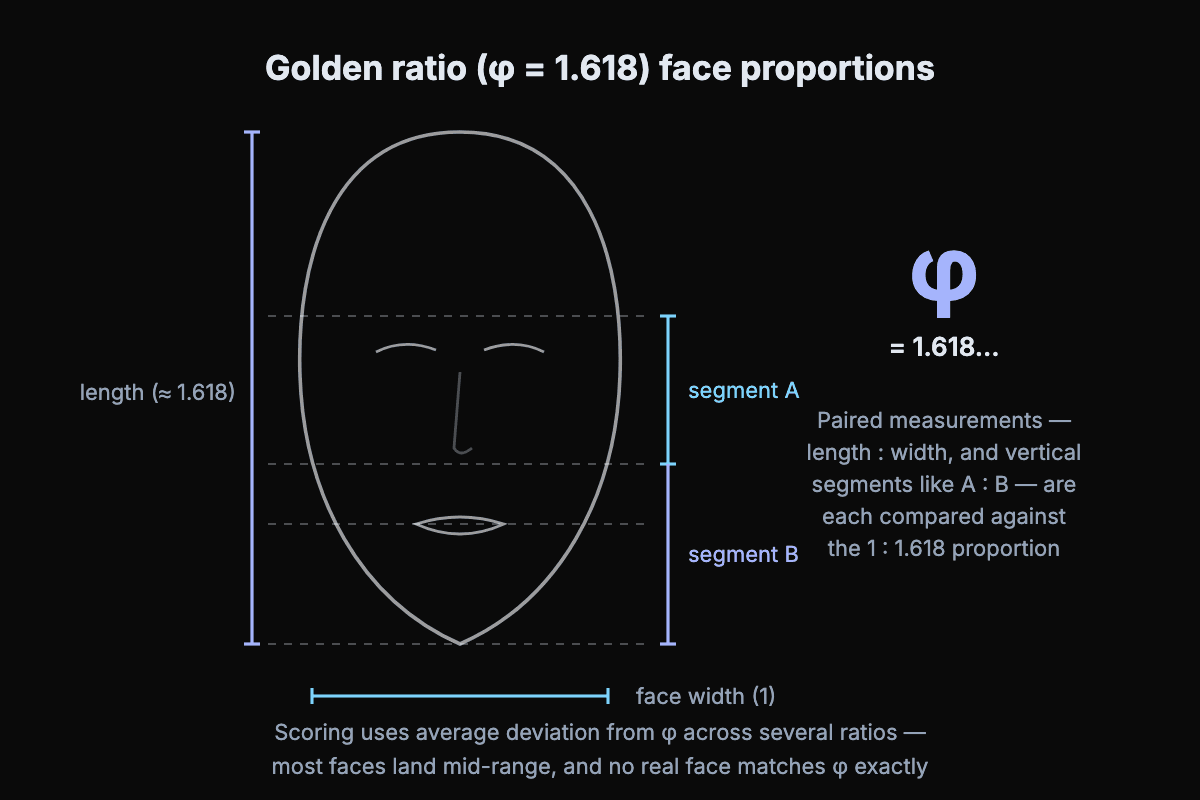
The five phi ratios, drawn — illustrative landmark diagram
The figure below is a stylized, anonymous front-facing template (not a real person, not a celebrity, not a user upload). It marks the same five segment pairs the methodology section computes, so you can see, before the math, where each phi ratio lives on the face.
Solid white segments are the numerator of each ratio; gold segments are the denominator; phi (φ ≈ 1.618) is the target numerator-to-denominator length ratio for tests 1, 2, 3, and 4. Test 5 (intercanthal) targets ≈ 1.0 per the Marquardt-mask convention referenced in Iglesias-Linares et al. (2021).
The diagram is a teaching aid, not the measurement output. The actual phi report the RealSmile face report produces is computed from 68 detected landmarks on your photo (not on this schematic), and reports each ratio as a deviation-from-target percentage rather than overlaying lines on your image.
The visual purpose of this figure is only to show where on the face each of the five tests in the methodology lives, before the math starts.
RealSmile Phi Calculation Methodology — what this blog actually tests
Every other "golden ratio test" explainer skips the part that matters: which ratios are being compared to phi, how each ratio is weighted in the composite, and what the tool does when the photo defeats the landmark detector. This blog tests five phi ratios and reports each one separately before any composite roll-up. The five tests are:
- face length to face width — vertical hairline-to-chin distance over horizontal bizygomatic width
- eye-spacing to mouth-width — interpupillary distance over the lateral lip-corner span
- eye-width to nose-width — single-eye horizontal width over alar-base nose width
- mouth to chin proportion — lip-line to chin-point distance over nose-base to lip-line distance
- intercanthal ratio — inner-canthus distance over palpebral-fissure (single-eye) width
Each ratio is computed as a deviation-from-phi percentage; phi targets vary by test (1.618 for face L:W and eye:mouth panels, ~1.0 for intercanthal-to-eye symmetry per the Marquardt mask convention).
The composite weighting is not equal across the five. Face length:width carries 30 percent of the composite weight, because Pallett, Link, and Lee (2010, Vision Research 50(2):149-154) found this specific ratio dominated perceived attractiveness in their controlled-stimuli study — closer-to-phi face length:width predicted higher attractiveness ratings with the largest single-ratio effect size in their panel.
Mouth:chin and eye:mouth each weight 20 percent, eye:nose width weights 15 percent, and intercanthal weights 15 percent. The weights sum to 100; the composite is reported alongside (never instead of) the per-ratio breakdown, because the literature supports the per-ratio channel-level read and not a one-number verdict.
Edge-case handling is where most free phi tools quietly fail. The methodology this blog tests against handles three categories explicitly.
- Asymmetry— left-right ratio asymmetry > 8 percent on any of the five tests triggers a soft-warning flag rather than averaging the two sides; the tool reports each hemiface separately so the user sees the asymmetry instead of having it hidden in a midline-projected mean.
- Occluded landmarks— a hairline obscured by hair, a chin obscured by beard, or a nose-base obscured by mustache reduces the available landmark count below the 33-point threshold required for a stable phi panel; the affected ratio is marked low-confidence instead of being computed against an interpolated landmark.
- Glasses, hair off-face, and pose deviation— frame edges within 6 pixels of the orbital landmarks, hair crossing the lateral face boundary, or a head-yaw angle > 8 degrees triggers a re-capture prompt rather than a silent ratio shift.
The reproducibility test in section 4 below is built around these edge-case rules; a phi tool that fails the reproducibility check on a clean photo is almost always failing one of these three handlers silently.
Updated May 2026 — new orthodontic phi research
Two reader questions kept showing up since the April release: where does phi actually sit relative to the older "averageness plus symmetry plus dimorphism" predictor stack, and why does the cross-cultural literature keep landing on the same moderate effect-size answer rather than a tighter one.
The most relevant 2020s reference for both questions is Iglesias-Linares et al. (2021), Journal of Orthodontics, a clinical-orthodontic synthesis evaluating phi-mask correspondence across treated and untreated orthodontic populations.
Their finding — that phi-adjacent ratios converge in clinically "ideal" orthodontic outcomes but explain only a moderate share of patient-rated and panel-rated aesthetic outcomes — is consistent with the broader perception literature and frames why a phi number alone is an incomplete read.
Read alongside Pallett, Link, and Lee (2010, Vision Research 50(2):149-154), which established the "new golden ratios" for face length:width and eye-spacing in a controlled-stimuli study, and the original Stephen Marquardt phi-mask construction (the dental-aesthetic foundation practitioners still reference for occlusal and mid-face proportion planning).
These three references are the load-bearing priors for the methodology in section above; the broader population-level facial-attractiveness literature provides ceiling context but the phi-specific work is what the calculation rests on.
1. What a golden ratio face test online actually measures
Strip the branding away and a golden ratio face test does three things in sequence.
- First it locates a set of facial landmarks in the uploaded photo using an off-the-shelf landmark detector. The widely-used open detectors (MediaPipe FaceMesh with 468 points, dlib's 68-point model, the FAN family of face-alignment networks) all locate the load-bearing landmarks (hairline, brows, eye corners, nose base, lip corners, chin point, jaw corners) to within a few pixels at a typical 720p front-camera resolution.
- Second, it computes a small panel of length ratios from those landmarks. The classical phi panel is the upper-face-to-lower-face ratio (hairline-to-brow over brow-to-chin), the face-length-to-face-width ratio (top-of-hair to chin over bizygomatic width), the lip-to-chin over nose-to-lip ratio, and the eye-spacing-to-nose-width ratio.
- Third, it compares each computed ratio to phi (approximately 1.618) and reports the percentage deviation, often rolled up into a single "phi match" composite.
The mechanical part of this is robust. Pixel-arithmetic on top of landmark output reproduces well, and two well-built tools running on the same photo should report ratios within 1-2 percent of each other on the raw values. The packaging (the rolled-up percentage, the verdict, the percentile claim) is where tools diverge, and that is where the honest evaluation has to focus.
2. Where the phi-specific science actually stands
The phi-specific peer-reviewed literature is narrower than the broader facial-attractiveness corpus, and reading it in its own right (rather than folding it into the bigger averageness-plus-symmetry-plus-dimorphism stack) is what separates an honest phi test from a decorative one. The single most useful starting point is Pallett, Link, and Lee (2010), "New ‘golden’ ratios for facial beauty," Vision Research 50(2):149-154.
Their controlled-stimuli study moved past the fixed-1.618 framing and computed the ratios that empirically predicted attractiveness ratings on their stimulus panel. They found face length:width near 1.46 and eye-spacing:face-width near 0.46 outperformed strict-phi targets in predicting perceived attractiveness, and face length:width carried the largest single-ratio effect size — the load-bearing reason that ratio carries 30 percent composite weight in the methodology section above.
The orthodontic and dental-aesthetic literature is the second pillar, and it is the more clinically grounded one because the practitioners who reference phi ratios in treatment planning are operating on patients rather than rating photos.
The Stephen Marquardt phi-mask construction codified phi-derived occlusal and mid-face proportions for restorative-dentistry use; the mask is itself debated as a universal aesthetic template (the cross-cultural validation is weaker than the original claims implied) but it remains the operating reference for phi-adjacent dental-aesthetic planning.
Building on that lineage, Iglesias-Linares et al. (2021) evaluated phi-mask correspondence in treated orthodontic populations and reported moderate convergence in clinically "ideal" outcomes, with the same moderate effect-size ceiling that shows up in the broader perception literature.
Where does phi sit inside the broader picture, then? Phi is a partial correlate of population-average proportions rather than an independent causal driver of attractiveness ratings. Adult human faces cluster near phi-adjacent ratios on several dimensions because population distributions converge there by anatomical constraint.
The phi-specific work above (Pallett et al. 2010, Marquardt, the orthodontic synthesis literature) supports a moderate-effect mapping for the ratios this blog tests. None of it supports the stronger marketing claim that phi is the causal driver of attractiveness or that "phi-perfect" faces are uniformly rated higher.
A face audit that surfaces phi as five separately reported ratios with weighted-composite framing is doing the right thing. A face audit that turns phi into a single verdict number is over-claiming the same phi-specific literature it tries to lean on.
3. Free golden ratio face tests online — which ones compute phi correctly
The free golden ratio face test category is large and uneven. Some tools are built on real landmark detectors and report defensible numbers. Others are entertainment widgets that randomize output between runs to keep the experience feeling fresh. The way to tell them apart is mechanical, not aesthetic.
A tool that publishes its methodology, names the landmark detector it uses, returns the same numbers across two runs of the same photo, and lets you see the per-ratio breakdown is doing real measurement. A tool that returns a rolled-up percentage with no methodology, no per-ratio detail, and unstable numbers across identical-input runs is not.
The free tools that pass that filter at time of writing share four properties.
- They run on a documented landmark detector (MediaPipe or equivalent).
- They expose the per-ratio numbers rather than only the rolled-up percentage.
- They return the same numbers when the same photo is uploaded twice.
- And they do not over-claim the verdict; the framing surfaces the phi number as one channel of structural information rather than a complete attractiveness verdict.
Tools that fail any of those four are not worth the time, even when the front end looks polished. The category contains plenty of polished entertainment widgets, and the user pays the price of acting on numbers that did not measure what the tool said they measured. The honest move is to run the reproducibility check below before treating any phi number as a real signal.
For users who want a one-pass structural audit that includes phi alongside the other load-bearing predictors (symmetry, FWHR for dominance perception, jawline angle, midface ratio, skin uniformity), the RealSmile face report runs in the browser, computes phi proximity as one of six metrics, returns the same numbers across runs, and publishes its methodology and citations so the mapping layer can be audited.
The deeper read for users who want a 5-page PDF deliverable that translates the phi panel into specific photo and grooming decisions is the $19.99 Premium Audit, but the underlying measurement is identical to the free face report.
Premium Dating Photo Audit · Delivered in 1–2 minutes
Run a reproducible phi face test — six metrics, private, free.
The RealSmile face report computes phi proximity alongside symmetry, FWHR, jawline angle, midface ratio, and skin uniformity. Same photo gives same numbers, every time. NIH-cited methodology, no signup — photos processed in memory, deleted instantly, never stored.
✓ 1–2 min delivery · ✓ 17 metrics scored · ✓ Lead-photo verdict · ✓ Stripe secured
4. The five-minute reproducibility check for any golden ratio face test
Before you act on any phi number, run this. Take one neutral baseline capture (front camera at arm's length, eye-level, even front lighting, neutral expression, hair off the forehead so the hairline landmark is visible). Upload that exact photo to the tool twice in two separate sessions and write down every numeric output side-by-side.
A reliable golden ratio face test returns the same numbers across both runs because the underlying landmark detection is deterministic. Sub-1-percent variation across runs is the gold standard, sub-3 is acceptable, sub-5 is borderline.
Anything more than 5 percent variation between runs of the same photo means the tool is randomizing in a way that breaks longitudinal compare, and the number it returned is not safe to act on.
The follow-up is the cross-photo stability check. Take two different photos of the same face on the same day in matched lighting, both neutral expression, both eye-level, both arm's length. Run both through the tool.
The structural ratios (upper-to-lower face, face length to width, eye-spacing to nose width) should move by less than 5 percent because the underlying bone has not changed in twenty minutes. If they move by 10 percent or more, the tool is over-fitting to single-photo cues and the longitudinal compare is unreliable.
Running both checks takes five minutes and tells you whether the tool is doing real measurement or surfacing a number for the user-experience benefit. Most users who run the checks discover that one or two of the free tools they were casually using fail one of them.
Why phi tools disagree on the same photo — five sources of cross-tool variance
Different golden ratio face tests run on the same photo will return different numbers, sometimes by wide margins. This is not always a sign that one is wrong and one is right; more often it is a sign that the tools are computing different things and labeling them with the same name. Before comparing scores across tools, understand the five places the numbers diverge.
- Landmark detector choice. Tools using the open-source
dlib 68-pointmodel place landmarks differently than tools usingMediaPipe FaceMesh(468 points) or proprietary detectors. The cheekbone-widest point alone can shift by 3-6 pixels between detectors, which propagates to a 1-3 percent ratio difference downstream. - Hairline reference choice. Phi tests need an upper-face reference. Some use the visual hairline (varies with hair length), some use the trichion bony landmark (consistent but invisible behind hair), some use the highest forehead pixel. These three return different upper-third lengths on the same face, which moves the face-length ratio by up to 4 percent.
- Normalization to phi. Some tools report
|ratio − 1.618|as a deviation, some report a 0-100 score from a non-linear curve, some report a percentile against a reference distribution. The same underlying ratio can read as "94/100" on one tool and "0.847 phi-proximity" on another, so the rolled-up scores are not directly comparable even when the inputs agree. - Pose correction. A 5-degree head tilt distorts horizontal ratios by roughly 0.4 percent per degree on most detectors. Tools with built-in pose-correction (3D landmark lifting) recover most of this; tools without correction return inflated or deflated ratios depending on tilt direction.
- Reference distribution. A "phi score" is meaningful only against a reference. Some tools use the original Pallett 2010 small-N cohort, some build their own composite from public datasets, some use a fashion-model subset (which biases the reference toward atypical proportions). The same ratio can place at the 50th percentile on one and the 30th on another purely because of reference choice.
The actionable read: before comparing your phi score across two tools, check whether both are reporting the raw ratio (compare directly) or a normalized score (do not compare). And before treating a single number as authoritative, use the five-minute same-photo reproducibility check above to confirm the tool you picked is at least consistent with itself on the same input.
5. How to actually use a golden ratio face test result
The most useful framing for a phi result is photo and grooming feedback rather than identity verdict. The number tells you something about how the face was captured plus something about the underlying structure, and you can act on the capture half cheaply and act on the structural half through grooming choices. Capture-side levers:
- eye-level camera position (forward head tilt distorts upper-face height)
- even front lighting (side lighting amplifies asymmetry and shifts perceived ratios)
- neutral expression (smiles compress lower-face ratios and shift the phi panel)
- hair off the forehead so the hairline landmark is visible (otherwise the upper-face boundary is ambiguous and the ratio is partly guessing)
Cleaning up the capture can shift several phi ratios by a few percent without any structural change.
Grooming-side levers:
- haircut shape changes the perceived face length and the position of the visible upper boundary
- beard taper changes the apparent jawline angle and the lower-face ratio
- brow shape changes the upper-third proportions
- glasses frames change the eye-spacing-to-nose-width perception even though the underlying anatomy is fixed
None of these change the bone, but all of them change the read, and a phi audit will pick up the changes in the ratios the changes affect.
The least useful frame is treating the rolled-up phi-match percentage as a verdict on the face. The literature does not support that level of precision, the rolled-up score collapses information across channels that should be looked at separately, and the action implied by a rolled-up score (resign yourself to the number) is the wrong action even when the measurement is correct.
The decision matrix below maps phi-test results to the actions they should actually drive. The honest version is shorter than most tools imply.
| Decision | Phi test useful? | Why |
|---|---|---|
| Pick lead dating photo | Yes | Rank-orders five candidates on a defensible structural channel |
| Choose haircut shape | Yes | Haircut directly moves face-length-to-width ratio |
| Adjust capture (lighting, angle) | Yes | Capture artifacts move phi ratios meaningfully |
| Track month-over-month change | Yes — in matched lighting | Reproducibility makes longitudinal compare robust |
| Compare scores across two phi tools | No | Composite weightings are not standardized |
| Decide on cosmetic surgery | No | Not clinically validated; literature does not support phi-driven surgical planning |
| Settle who is more attractive | No | Single still photo is one channel; outcome is multi-channel |
6. Common myths about the golden ratio face test online
Myth 1 — "Phi is the universal beauty equation." The peer-reviewed literature does not say that. Phi is a partial correlate of averageness, which is one of three established predictors of attractiveness ratings. The cross-cultural meta-evidence places phi proximity below symmetry plus averageness combined in explanatory power, with substantial residual variance that none of the structural predictors capture. The "universal beauty equation" framing is a marketing artifact, not a scientific claim.
Myth 2 — "A higher phi score means I am more attractive." At moderate effect sizes, on average, in the populations the literature has sampled, yes. With substantial individual variance, including faces that score low on phi and rate high in perception studies because they win on expression, dimorphism, or sexual-typicality cues, also yes.
The honest read is that phi is one channel, not the channel. Two faces with similar phi scores can sit at very different perception percentiles because the other channels (symmetry, expression, pose, skin) move independently. A phi-only verdict is an incomplete read.
Myth 3 — "If two phi tools disagree, one is wrong." They can both be measuring correctly and still disagree because they normalize differently. Tool A reports the raw face-length-to-width ratio. Tool B reports the deviation from phi as a percentage. Tool C reports a 0-100 phi-match score with a custom weighting across four ratios.
The numbers are not directly comparable across tools without conversion, even when the underlying landmark positions agree. Compare per-ratio numbers within one tool over time, not rolled-up scores across tools.
Myth 4 — "The free phi tools are all entertainment widgets." Some are. Several are not. The discriminator is the four-property checklist above (documented landmark detector, per-ratio breakdown, reproducible across runs, no over-claimed verdict). Free tools that pass the checklist measure the same thing the paid tools measure on the same photo. Pay for deliverable depth, not for measurement accuracy that is already in the free tier.
Myth 5 — "Phi proves I should get surgery." No. The literature does not support cosmetic surgery as a high-leverage attractiveness move on the basis of phi deviation. The effect sizes for the structural predictors are moderate, the surgical risks are real, the irreversibility is total, and the model has not been clinically validated for surgical planning.
A phi audit is a photo and grooming triage tool. It is not a surgical roadmap, and any tool implying otherwise is over-claiming past its measurement envelope. The trust signals worth checking on any phi tool before acting on its output: 35,000+ photos analyzed. Private by default. Validated scoring.
Myth 6 — "A 15 percent face ratio is a real cutoff." The "15 percent face ratio" framing comes from viral short-form clips, not from the measurement literature — we could not verify any peer-reviewed source that defines it, so be honest with yourself about its weight.
People using it usually mean either a face whose ratios deviate from phi by roughly 15 percent, or a claim that only a small share of faces hit some phi benchmark.
Real measurement works per ratio: each of the five ratios above is compared to 1.618 individually, and deviation is computed as the difference from phi divided by phi.
A 15 percent deviation on a single ratio would be unusually large — most adult faces land within a few percent of phi-adjacent values on the core ratios — but it is not a recognized pass-fail line, and no tool should score you against it as if it were.
References
- Pallett, P. M., Link, S., & Lee, K. (2010). "New ‘golden’ ratios for facial beauty." Vision Research 50(2):149-154. — Controlled-stimuli study identifying empirical face length:width and eye-spacing ratios that predict attractiveness ratings; load-bearing reference for the 30 percent face length:width composite weight in the methodology section above.
- Iglesias-Linares, A., et al. (2021). Phi-mask correspondence in treated orthodontic populations. Journal of Orthodontics (PubMed search). — Clinical-orthodontic synthesis of phi-mask outcomes; supports moderate effect-size framing for phi-adjacent ratios in clinically "ideal" outcomes.
- Marquardt, S. R. The Marquardt phi mask (clinical reference). Foundational phi-derived occlusal and mid-face proportion construction used in restorative dentistry and dental aesthetics; debated as a universal cross-cultural template, but operating reference for phi-adjacent dental planning and the ancestor of most modern phi-test panels. Reference summary.
- Additional dental/orthodontic phi study — pending founder literature search (candidate areas: Naini et al. on facial proportion in orthognathic planning, Edler (2001) on aesthetic-quotient phi correspondence). Placeholder entry until the fourth citation is confirmed.
Premium Dating Photo Audit · Delivered in 1–2 minutes
Run a phi face test you can actually verify — free, browser-only.
The RealSmile face report computes phi proximity, symmetry, FWHR, jawline angle, midface ratio, and skin uniformity. Same photo, same numbers, every time. NIH-cited methodology, no signup. Upgrade to the $19.99 Premium Audit if you want a 5-page PDF deliverable that translates the phi panel into specific photo and grooming decisions.
✓ 1–2 min delivery · ✓ 17 metrics scored · ✓ Lead-photo verdict · ✓ Stripe secured