Measure your canthal tilt in 60 seconds
Some people look for a canthal tilt calculator and some for a canthal tilt checker; this is both — the angle is measured from your photo, in degrees, in the full report, with the eye-corner landmarks it used drawn on your photo.
The direct answer, in plain words — the full script of our 60-second canthal tilt explainer:
What is canthal tilt? And can you actually change it?
It's the angle of a line from your inner eye corner to your outer one. Upward reads positive. Level or down, neutral or negative.
It's a measurement of an angle. Not a rating of you.
Tilt your head back, and the same eyes read more positive. That's the camera, not your face.
Can you change it? Honestly, no. It's set by the bone around your eye. And you didn't do anything wrong.
You can change how it reads. Lens slightly above eye level, chin a touch down. That changes the photo, not your face.
See your own tilt measured cleanly. One of seventeen measurements, free, at realsmile.online.
What is canthal tilt?
Canthal tilt is the angle between the medial canthus (inner corner of the eye) and the lateral canthus (outer corner), measured against a horizontal baseline when looking straight ahead.
It is a standard measurement in aesthetic medicine, and perception research links the surrounding eye-region geometry to reads of youth and alertness — the tilt itself is an angle in degrees, not a rating of you.
So the canthal tilt meaning is purely geometric: it describes where your outer eye corner sits relative to the inner one, and nothing more.
The measurement is simple: draw an imaginary line from the inner corner to the outer corner of each eye. If that line tilts upward toward the temples, you have a positive canthal tilt. If it's level, you have a neutral tilt. If it tilts downward, you have a negative canthal tilt.
Most people have a slight positive or neutral tilt. Significant negative tilt (below -3°) is associated with fatigue, premature aging, and is one of the primary targets of cosmetic eye surgery. Strong positive tilt (+5° to +10°) creates the "almond eye" or "fox eye" aesthetic that dominates high-fashion and looksmaxxing discussions.
Quick glossary — terms used on this page
Skim if you already know them. Each term links back to the term's full definition where one exists.
| Term | What it means |
|---|---|
| Medial canthus | The inner corner of the eye, where the upper and lower eyelids meet near the nose. Reference point for the start of the canthal-tilt measurement line. |
| Lateral canthus | The outer corner of the eye, where the upper and lower eyelids meet toward the temple. Reference point for the end of the canthal-tilt measurement line. |
| Palpebral fissure | The horizontal opening between the upper and lower eyelids. Length and shape of this opening combine with canthal tilt to produce "almond" vs "round" eye reads. |
| Canthopexy | Cosmetic surgery that lifts the lateral canthus tendon to add positive tilt. Less invasive than canthoplasty; results are subtler and partly reversible with healing. |
| Canthoplasty | Cosmetic surgery that re-positions the lateral canthus structurally for permanent tilt change. Higher complication rate than canthopexy; revisions are common. |
| Scleral show | Visible white (sclera) above or below the iris when looking forward. Higher scleral show often pairs with neutral or negative tilt; minimal scleral show is part of the "hunter eyes" composite read. |
Positive canthal tilt vs. neutral vs. negative — what each means
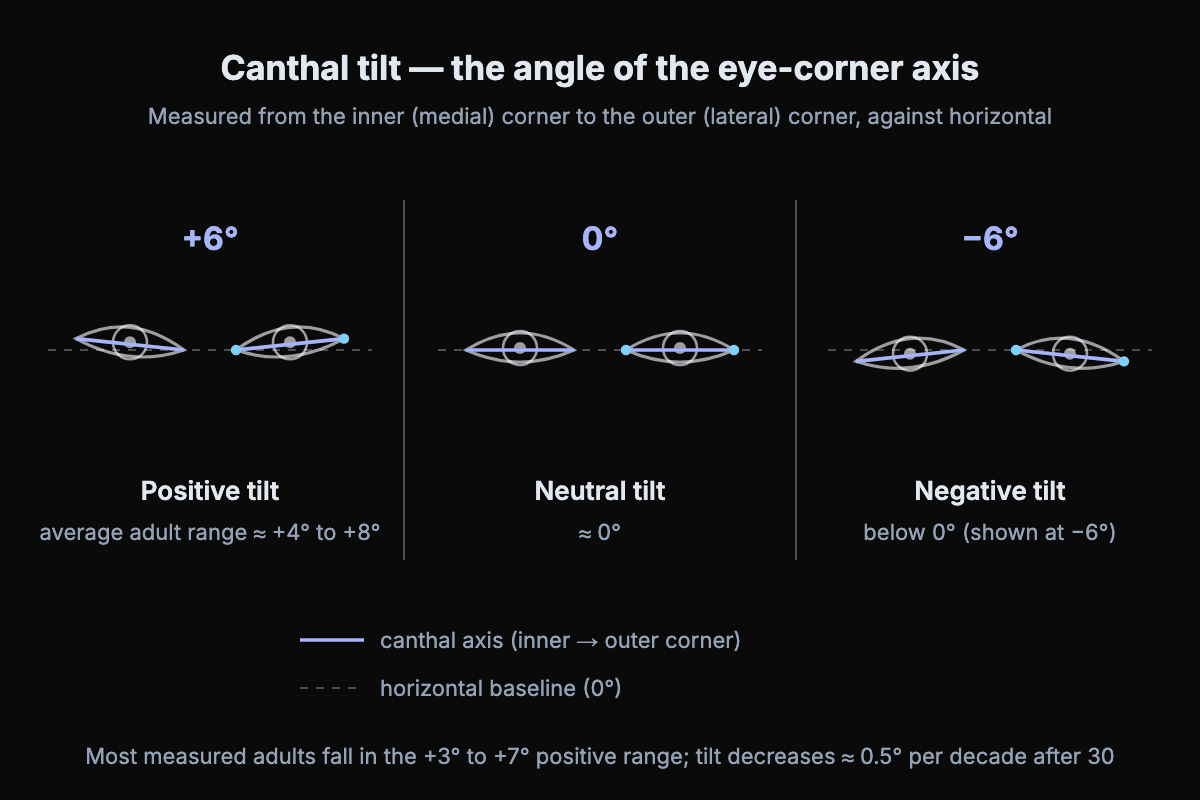
| Tilt | What it means |
|---|---|
| Positive+3° to +10°Outer corner higher |
|
| Neutral-2° to +2°Same height |
|
| Negativebelow -2°Outer corner lower |
|
What is a negative canthal tilt?
A negative canthal tilt means the outer corner of the eye sits lower than the inner corner — the measured eye-corner axis dips below horizontal, typically past −2°.
It is a geometry reading, not a verdict: the same eye can measure negative in one photo and neutral in another, because the angle is pose-sensitive. That's why the scan flags results taken with a tilted head instead of reporting them as fact.
What does your canthal tilt look like?
Reference the abstract examples below to calibrate your reading. Each card shows a stylized eye-pair with the inter-canthal axis (dashed) and tilt arc against horizontal.
Negative tilt
Outer canthus sits lower than inner. Reads as downturned or tired.
Neutral
Inner and outer canthi sit on the same horizontal line.
Positive tilt
Outer canthus higher than inner. Most rated attractive in perception studies.
Schematic eye references — not real measurements. Actual canthal-tilt math runs on your photo's landmark points.
| Basis | What it supports |
|---|---|
| Research-backed | Eye-region geometry consistently appears in attractiveness models (Rhodes 2006, PMID 16318594). Specific canthal-tilt-to-attractiveness studies are less common than overall facial-symmetry research. |
| Community-observed | The "positive tilt is more attractive" framing is common in looksmaxxing communities and aligns with general findings on eye-area youthfulness signals — but the specific degree-attractiveness gradient is mostly anecdotal, not directly measured in published studies. |
How to measure canthal tilt
| Step | What to do |
|---|---|
| 01Identify the medial canthus | The medial canthus is the inner corner of the eye — the small pink area nearest the nose where the upper and lower lids meet. This is the starting point for the measurement. |
| 02Identify the lateral canthus | The lateral canthus is the outer corner of the eye, farthest from the nose. This is the endpoint of the measurement line. |
| 03Draw the canthal axis | A line connecting the medial and lateral canthus forms the canthal axis for that eye. This is typically measured on both eyes and averaged for a bilateral reading. |
| 04Measure the angle | The angle between the canthal axis and a true horizontal baseline (parallel to the floor) gives the canthal tilt in degrees. Positive values indicate upward tilt; negative values indicate downward tilt. |
What research says about canthal tilt and attractiveness
Canthal tilt is a standard measurement in aesthetic medicine and oculoplastic surgery, and eye-region geometry appears consistently among the correlates in facial-attractiveness research (Rhodes, 2006).
Evolutionarily, positive canthal tilt is associated with youth. Canthal tilt naturally decreases with age — the lateral canthus droops as the lateral orbital retaining ligament weakens and periorbital fat redistributes. This means that a positive tilt reads as a youth signal, which is why it correlates with attractiveness ratings.
In cosmetic surgery literature, restoring or creating positive canthal tilt is one of the goals of canthoplasty and canthopexy procedures. Studies on post-operative patient satisfaction and rater attractiveness scores consistently show improvements after tilt correction, supporting the hypothesis that positive canthal tilt is a genuine attractiveness feature rather than a cultural trend.
Which tilt reads as attractive also depends on the face. Comparing average and attractive composite faces of seven ethnic groups, Rhee, Woo & Kwon (2012) found that attractive Caucasian and African faces had a steeper eye slant than their group's average face, while attractive Asian faces had a less steep one.
What our data shows
Our scanner has processed 35,000+ faces, and canthal tilt is one of the most requested single metrics. Your score is placed against the first scans of about 2,100 RealSmile users, whose median tilt is +3.7°: that median scores 50, and a more positive tilt scores higher.
The scan computes the angle for each eye from the line between the outer and inner eye corners, averages both eyes, and scores the result on a smooth curve that rises with more positive tilt and is centred on the RealSmile scanners' median of about +3.7°. It displays 4–7° as the ideal range.
Canthal tilt is also the strongest of the three markers in the hunter eyes test, and the surrounding eye-area geometry feeds the brow bands scored in the masculinity test.
It's a measurement of an angle. Not a rating of you.
Can you improve your canthal tilt?
| Lever | What it does |
|---|---|
| Reduce body fatModerate | Lower body fat reduces periorbital fat pads and under-eye puffiness, which creates a cleaner canthal angle and makes a neutral tilt read closer to positive. Dropping from 20%+ to 13-15% body fat has a visible effect on eye area definition. |
| Improve sleep qualitySmall but fast | Sleep deprivation causes periorbital edema (swelling around the eyes) which droops the lateral canthal area and makes a positive tilt look neutral. Good sleep hygiene — 7-9 hours, reduced sodium, and head-elevated sleeping — visibly improves the eye area within days. |
| Photo angleSignificant in photos | Camera angle dramatically affects how canthal tilt reads in photos. Shooting from slightly above eye level (the camera looking slightly downward at you) tightens the under-eye area and makes positive tilt more pronounced. This is the standard angle for attractiveness-optimized photos. |
| Canthopexy / canthoplasty surgeryPermanent, high risk | Canthopexy repositions and tightens the lateral canthal tendon to lift the outer corner. Canthoplasty involves cutting and repositioning the canthus itself for more significant structural change. Both are legitimate cosmetic procedures but carry surgical risks and require experienced surgeons. |
Measure your canthal tilt now
The scan measures your canthal tilt angle in degrees as part of the 17-measurement read — symmetry, jawline, FWHR, hunter eye index, and more. Free scan; full report $14.99.
Get my canthal tilt score →Canthal tilt to action — what to do at each angle band
Canthal tilt is one of the most over-indexed metrics in the looksmaxxing community. The angle is mostly bone-determined, but reads on a face can shift dramatically with brow position, under-eye support, and photo angle. The map below converts your measured tilt into the correct intervention band — most readers benefit from the soft-tissue and photo levers long before considering anything clinical.
| Angle band | What to do |
|---|---|
| Strong positive (>5°) | Already in the asset range. No intervention. Lever: photograph in good light at eye-level so the asset reads. Avoid downward angles that flatten the tilt. |
| Mild positive (2-5°) | Common, attractive band. Soft-tissue levers (brow lift via training, under-eye care, sleep) maximize what is already there. Photo angle matters more than cosmetic intervention here. |
| Neutral (-2° to +2°) | Reads neutral on most faces. Strongest non-clinical levers: brow shape and density, glasses frame angle, hair part position. These shift perception by 2-3° equivalent without surgery. |
| Negative (<-2°) | Genuinely negative tilt is uncommon and a research-not-react read. If a paid audit confirms it as a primary detractor (rare — usually the perceived issue is brow or under-eye, not tilt), only then is consultation reasonable. |
The two failure modes this map prevents: (1) panicking on a neutral read because the looksmaxxing forums treat anything below +5° as a flaw, and (2) jumping to canthoplasty when the perceived issue is actually brow shape or under-eye, both of which are far cheaper and reversible.
Frequently asked questions
What is canthal tilt?
Canthal tilt is the angle between the inner and outer corners of the eye, measured relative to horizontal. A positive tilt means the outer corner is higher; negative means the outer corner is lower.
What degree of canthal tilt is considered attractive?
No published study maps an exact degree-to-attractiveness gradient — any single "most attractive angle" you see quoted is invented. Perception research consistently favors a mildly positive tilt, and aesthetic-surgery practice commonly treats roughly +2° to +8° as the preferred band.
What is the difference between canthal tilt and hunter eyes?
Canthal tilt is a specific clinical measurement. Hunter eyes is a broader aesthetic concept involving canthal tilt plus hooded eyelids, low scleral show, and a defined brow ridge. Positive canthal tilt is one component of hunter eyes.
Can I measure my canthal tilt at home?
Yes. Take a front-facing photo with your head level and eyes looking directly at the camera. Draw a line from your inner eye corner to your outer eye corner and measure the angle relative to horizontal. Our face scan measures it from a selfie as one of its 17 measurements: the free scan shows your Face Score and strongest metric, and your tilt in degrees is in the full report.
Does canthal tilt change with age?
Yes. The lateral canthus tends to droop as the canthal tendon loosens with age, which lowers the tilt. This is why restoring positive tilt is a common goal of eye-area cosmetic procedures.
Is a negative canthal tilt bad?
No — a mildly negative tilt is within normal human variation. Most RealSmile scans measure a positive tilt, so a negative tilt is simply less common.
It can read as tired in photos, but it is one metric out of 17, and lighting, brow shape, and under-eye puffiness often account for more of the read than the angle itself.
What canthal tilt do models have?
No peer-reviewed study has published measured canthal tilts for professional models, so any specific "model tilt" number you see quoted is invented. What the research does support: positive canthal tilt is one of the strongest single-metric correlates of perceived attractiveness.
The "model look" people describe usually corresponds to a clearly visible positive tilt combined with brow position and eye shape, not the tilt alone.
Can your two eyes have different canthal tilts?
Yes — small left-right differences are common. The scan measures each eye separately, taking the angle of the line from the outer to the inner eye corner against horizontal, then averages the two for your reported tilt.
A degree or two of difference between eyes is ordinary asymmetry: no face is perfectly symmetrical, and self-perceived asymmetry consistently exceeds what is actually measured (Rhodes, 2006).
Does head tilt in a photo affect your canthal tilt result?
Yes, more than almost anything else. Canthal tilt is measured against a horizontal reference line, so if your head is rotated a few degrees in the photo, that rotation is added to or subtracted from the measured angle of both eyes.
Take the photo with your head level, the camera at eye level, and your eyes looking straight ahead — and if a result looks off, retake before reading anything into the number.
8-metric suite
Your complete looksmax scorecard
One AI scan measures all 8 metrics from a single selfie. You've explored one — get the full picture.