Facial Symmetry Test: How Symmetrical Is Your Face?
The analyzer below shows your facial symmetry score as a free tier; the exact 0–100 number is in the full report. AI compares 11 mirrored landmark pairs — jaw contour, eyes, brows and mouth corners.
Free to try, private by default. On desktop your photo is analyzed in your browser; on mobile it is processed in memory and deleted instantly. Nothing is kept unless you choose to save it.
17 metrics · 68 landmarks · Processed in memory, deleted instantly unless you choose to save it
Free scan: Face Score + strongest metric · full report $14.99
Or open the scanner without a photo →Or get the written audit ($19.99) →How symmetrical is the average face?
No face is perfectly symmetrical — measurable left-right differences are universal, and self-perceived asymmetry is usually larger than what is actually measured (Rhodes 2006 meta-analysis; Grammer & Thornhill 1994). RealSmile compares 11 mirrored landmark pairs (jaw contour, eyes, brows and mouth corners) and outputs a single 0–100 symmetry index. The index is a measurement of balance, not an attractiveness rating.
- Full report: your symmetry score 0–100, placed against RealSmile scanners (50 = the median)
- Symmetry axis and paired landmarks drawn on your photo
- Full report: your three weakest metrics, ranked by how fixable they are
- Private by default — processed in memory, deleted instantly unless you choose to save it
Your Symmetry Score
Upload a front-facing photo to get your score
Reading is one thing — knowing yours is another
Measure YOUR Facial Symmetry
Upload one selfie and the scanner calculates 17 facial measurements, including symmetry, canthal tilt and facial thirds, in under 10 seconds. Your Face Score and strongest measurement are free, no signup.
Scan my face free →Upload a selfie
Get scored, free
Unlock the report
Before you measure: 3-question photo readiness check+
Symmetry scores are photo-sensitive. Spending 10 seconds answering these mentally gets you a more accurate first-attempt result.
Is your full face visible — forehead to chin — with both ears at least partially visible?
Symmetry math compares left-side landmarks to right-side landmarks. If one ear is cropped or your forehead is cut off, the AI loses anchor points and reports symmetry as worse than it actually is.
If no: Pull the camera back 6-8 inches and re-frame so your whole head sits inside the frame with margin.
Is your face lit evenly — no strong shadow on one cheek or one side of the jaw?
Hard side-lighting creates a contrast difference between the two halves of your face. The AI can read the shadow as a structural asymmetry — even though it's just light. This is the #1 cause of inaccurate symmetry scores.
If no: Face a window or stand between two lamps. Diffuse light (overcast day, white wall reflection) reads cleanest.
Is your head level (not tilted left or right) and your gaze straight at the camera (not looking up or down)?
Even 5° of head tilt rotates one side of your face closer to the camera and exaggerates that side's features. The AI tries to correct for tilt but accuracy drops as tilt increases. Down-tilt elongates the chin; up-tilt shortens the forehead.
If no: Hold the phone at eye-height. Look directly into the lens. Square your shoulders to the camera.
If you answered yes to all three, your photo is ready. If you answered no to any, fix that before uploading — the score you'd get with a bad photo isn't your symmetry, it's the photo's noise. Re-shoot the photo, not the face.
What does the facial symmetry test measure?
The scan reads several dimensions of facial balance from the geometry of your photo; it does not score expression. Symmetry is one of the 17 measurements — see what each measurement means before reading too much into any single number.
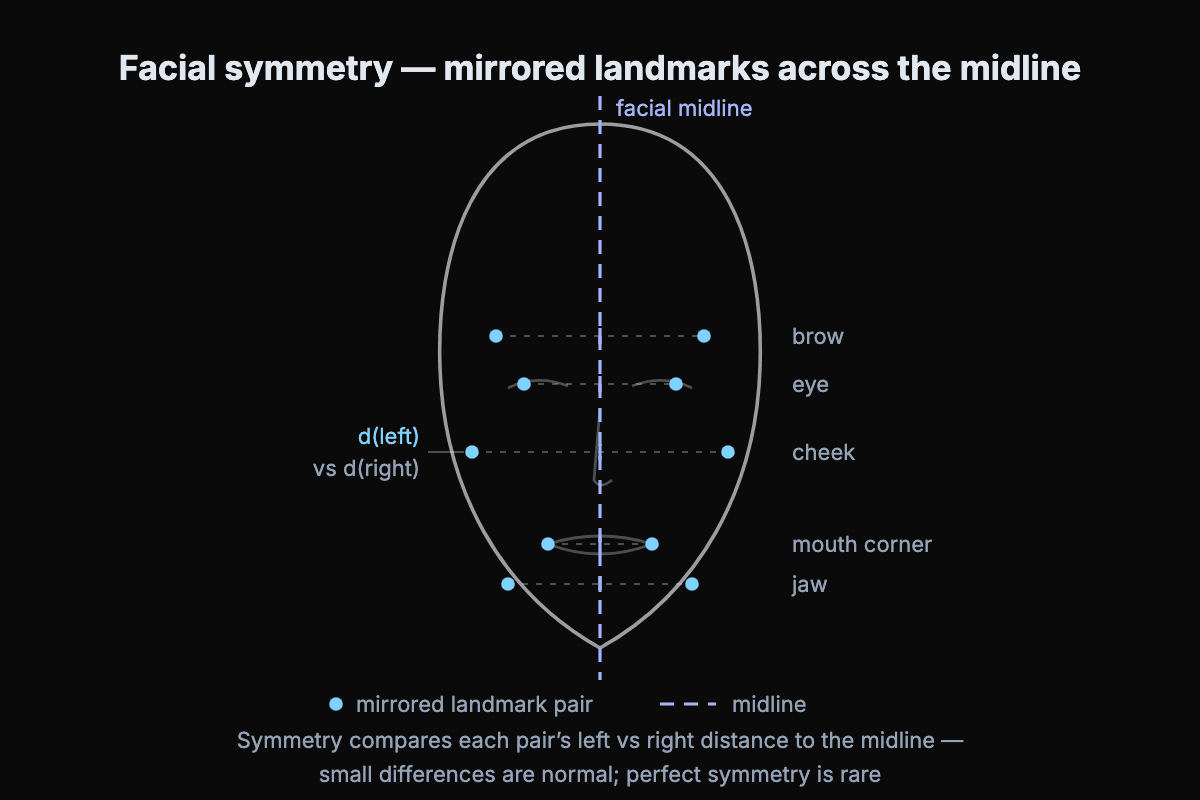
Left-Right Balance
Measures how closely the left and right sides of your face mirror each other across 11 landmark pairs — jaw contour, eyes, brows and mouth corners.
Facial Proportions
Analyzes the proportional relationships between your facial features — spacing between eyes, nose-to-chin ratio, facial thirds.
Mouth-Corner Balance
Compares how far each mouth corner sits from the midline of your face, one of the 11 mirrored pairs. A lopsided smile or a pulled lip moves them, so use a relaxed, closed mouth.
Eye & Brow Alignment
Compares how far each eye and each brow sits from the midline of your face, two of the 11 mirrored pairs. A turned head shifts them.
What the science says about facial symmetry+
Research across multiple cultures shows that facial symmetry is consistently rated as attractive — it's one of the most universal beauty signals. Evolutionary biologists believe this is because symmetry signals developmental health and genetic fitness.
However, the research also shows something important: no face is perfectly symmetrical. Everyone has asymmetries. Studies found that even faces rated as highly attractive typically have measurable left-right differences.
Symmetry is also not the whole story in real-world photos — dating apps, LinkedIn, social media. Expression changes how the same face reads: a slightly asymmetrical face with a relaxed, warm expression can read better than a more symmetrical face with a tense one, and no symmetry number captures that.
RealSmile's scan measures geometry only: your symmetry score tells you about your photo's balance, and expression is not scored. If you want symmetry placed alongside the broader proportion picture, our data-driven face proportion analysis walks through how the two metric families interact. Vertical proportion is its own axis, too — the free facial thirds test measures your upper, middle, and lower third split, which left-right symmetry alone never sees.
Symmetry isn't the only beauty driver — research finds at least three
Most symmetry tools give you one number and stop. The peer-reviewed literature is more nuanced.
Symmetry
Bilateral matching of paired features
Moderate effect size in perception studies. Higher symmetry consistently rates more attractive across cultures and age groups.
Averageness
Closeness to the population mean
Often the largest effect. Composite-averaged faces are reliably rated more attractive than individual faces — counterintuitive but well-replicated.
Sexual Dimorphism
Pronounced sex-typical features
Stronger jawlines (male), softer features (female) consistently rate higher in standard perception batteries — though preferences vary by context.
All three findings come from Rhodes 2006 (PMID 16318594), a peer-reviewed meta-review of decades of facial-attractiveness research. The same paper finds averageness often has a larger effect on perceived attractiveness than symmetry alone — useful context if your symmetry score is lower than expected. For executive-presence contexts (LinkedIn, About-page, sales decks) symmetry weights differently than for dating — the LinkedIn / Executive Pro Audit re-weights the same 17 metrics for competence and trust signals.
Schematic asymmetry levels — for reference
Schematic — not real measurements. Actual symmetry math runs on landmark points from your photo.
How to improve facial symmetry in photos+
You can't change your bone structure, but you can dramatically improve how symmetrical you look in photos.
Face the camera directly
Even a slight head tilt creates asymmetry in photos. Face the lens straight-on for the most balanced result. Use your phone's grid lines to align.
Use even lighting
Uneven lighting creates shadows that make one side of your face look different from the other. Soft light from directly in front of you (like a window) creates the most symmetrical look.
Camera at eye level
Looking up or down at the camera distorts facial proportions. Position your phone at exactly eye level for the most accurate, symmetrical framing.
Relax completely
Facial tension creates asymmetry — one eyebrow raised, mouth pulled to one side, jaw clenched. Take a deep breath and let every muscle in your face relax before shooting.
How does the facial symmetry test work?
Upload a Front-Facing Photo
For best symmetry results, use a photo where you're looking directly at the camera with even lighting.
AI Maps Your Face
Our AI detects facial landmarks and measures left-right balance across 11 mirrored pairs, alongside the other facial proportions.
Get Your Symmetry Score
See your symmetry tier free; the full report gives the exact 0–100 score and specific tips to improve your next photo.
Private by Default
On desktop your photo is analyzed in your browser; on mobile it is processed in memory and deleted instantly. Nothing is kept unless you choose to save it. Most symmetry test tools keep your selfies on their servers.
Instant Results
See your symmetry tier in seconds with the analyzer on this page. No credits, no signup required.
Compare Angles
Upload photos from different angles to see which one shows the best symmetry. Find your most balanced photo.
Facial symmetry in 60 seconds — why the camera exaggerates it
The episode as straight text — no fluff, no dodge:
How symmetrical is your face? And before you panic, no one is perfectly symmetrical.
Symmetry compares the left and right halves across the midline of your face.
A commonly cited range, not a law. Small differences are normal, and they are not a flaw.
Here is the big one. Side lighting and a slight head turn manufacture asymmetry your face does not actually have.
Is it fixable? Partly. Bone asymmetry is usually tiny. Most of what you see in a photo is the light and the angle.
Shoot front on, with a single even light at eye level. That removes the fake asymmetry. It changes the photo, not your face.
See how yours measures. One of seventeen measurements, free, at realsmile.online.
Is my face symmetrical? How to actually check
You can't judge it in the mirror — your brain normalizes the face it sees every day, and the mirror shows you a flipped version you've learned to accept. The mirror-flip apps that overlay two left halves or two right halves exaggerate in the other direction: nobody looks normal as a composite of one duplicated half, so those images always read as more asymmetrical than the real face.
The reliable way to check is measurement: a front-on photo, even lighting at eye level, and a landmark comparison of matched left-right pairs — jaw contour, eye and brow centers, mouth corners — against the facial midline. That's what this test does: it compares 11 mirrored pairs and gives you one symmetry reading, instead of leaving you squinting at a flipped selfie.
What percentage of facial symmetry is normal?
There is no research-backed percentage cutoff that separates a "symmetrical" face from an "asymmetrical" one — treat any site that promises one with suspicion. What the research does show is that measurable left-right differences are universal (Grammer & Thornhill 1994; Rhodes 2006): a 100 on any 0–100 symmetry index doesn't occur in real faces. In practice, most of the variation between your own photos comes from lighting direction and head angle, not bone. So read your score as a comparison — against your other photos and against other RealSmile scanners, where 50 is the median — rather than as a pass/fail grade.
Facial Symmetry Test FAQ
How does the facial symmetry test work?+
Does facial symmetry determine attractiveness?+
Can I improve my facial symmetry?+
Why does my symmetry score change between photos?+
What is the golden ratio and does this test measure it?+
Is this facial symmetry test free?+
Test your facial symmetry now
Free, instant, private. The free scan gives your Face Score and strongest metric; the full report scores your symmetry 0–100.
Free scan · full report $14.99
Test Your Other Metrics
Each test measures a different facial metric. Run them all to get the full picture.
Improve your results
Skin picks
General skin picks. Symmetry is measured from landmark positions, which skin care does not move.
Picked by topic, not from your scan. Affiliate links. As an Amazon Associate, RealSmile earns from qualifying purchases. Our product guide →
Hyaluronic Acid 2% + B5 with Ceramides 1oz
On Amazon →The Ordinary
Dehydrated skin creates fine-line texture visible even in flattering light. HA draws water into the dermis, instantly smoothing and plumping — particularly around the eye area and smile lines.
Results in 1-2 weeksCeraVe Foaming Facial Cleanser
On Amazon →CeraVe
Clear, even skin simply photographs better. A gentle daily cleanser is the baseline every skincare routine builds on.
Results in 1-2 weeksBioré UV Aqua Rich Daily Hydrating Facial Moisturizer SPF 50
On Amazon →Bioré
UV is the biggest driver of premature skin ageing. Daily SPF protects collagen and keeps skin clearer and more even — a skin-quality lever that photographs better over time.
PreventiveRecommended Reading
Premium Dating Photo Audit · Delivered in 1–2 minutes
Get your dating photos audited.
Rank 2 to 6 photos free and see which one should lead. Then unlock the full written audit on up to 10 photos — each photo ranked with its strongest and weakest metrics, what to delete, three reshoot fixes, a 20-dater AI voter panel + downloadable PDF — for $19.99.
✓ 1–2 min delivery · ✓ 17 metrics measured · ✓ Lead-photo verdict · ✓ Stripe secured
Go deeper · Full Looksmax Report
Get the full Looksmax Report
You ran a quick scan. The full Looksmax Report scores every metric your photo supports (typically 15 of the 17) from 0 to 100 and gives a 30-day glow-up plan.
✓ Instant unlock · ✓ No subscription
Try next
Try our other tools
All free. All private. All instant.
Smile Analyzer
Is your smile genuine or forced?
Golden Ratio Test
How close are your proportions to φ?
Face Score
AI attractiveness analysis
Face Rating
Rate my face 1–10
Attractiveness Test
How attractive am I?
Rank My Photos
Which photo gets more matches?
Headshot Ranker
Best photo for LinkedIn
Looksmaxxing Test
Your glow-up score
Photogenic Test
Is it your face — or the photo?
Related on RealSmile
Hand-picked from 90+ tests, guides, and audits.
Jawline Test
Measure your jaw angle and definition
LooksmaxLip Shape Analysis
Shape, fullness ratio, vermilion border
LooksmaxLooksmaxxing Test
Your free Face Score, plus every metric your photo supports
LooksmaxMasculinity Test
How masculine does your face read?
DatingDating Photo Ranker
Rank your 6 photos by predicted match rate
Pro / LinkedInHeadshot Ranker
Score your LinkedIn / pro photo