Facial thirds test — are your thirds balanced?
The Vitruvian ideal is 1:1:1 — upper, middle, and lower thirds equal. Upload a photo, see which third is throwing your face off and by how much.
Measure my thirds freeYour facial thirds are one of 17 metrics that determine perceived attractiveness.
Thirds ratio alone won't tell you why your face reads the way it does. The full audit scores canthal tilt, jawline angle, FWHR, hunter eyes, and 13 more metrics — then a human-written 5-page PDF tells you which to fix first.
Sample thirds result
Your thirds ratio
31 : 36 : 33 → long midface
Midface 3pt over ideal · Lower third in range · Upper 2pt under
Upper
31%
Middle
36%
Lower
33%
Sample numbers. Run the test below for your actual thirds distribution.
Your results expire after this session — save or screenshot
Your Facial Thirds Score
Upload a front-facing photo to get your score
Upper third the one reading long? Take the big forehead test — it measures the forehead share specifically.
Measure your facial thirds in 60 seconds
This is how to measure facial thirds, and it doubles as a facial thirds test online: equal facial thirds are the commonly cited ideal, so an equal facial thirds test is really just a check of how close one photo sits to that range. People arriving from looksmax threads sometimes call a low reading a sub 3 face — that is their slang, not a verdict this page issues.
Every word of our 60-second facial thirds explainer, on the page:
What are facial thirds? And does balanced actually mean better?
Divide the face at the brows and the base of the nose. Forehead, midface, lower face. Three bands.
Roughly equal thirds is a commonly cited range. It's not a law, and balanced thirds don't make anyone a better person.
Tip your chin up and your lower third stretches. That's the camera, not your face.
Can you change them? Honestly, no. Thirds are set by bone. You didn't do anything wrong, and uneven thirds are not a flaw.
A fringe or a different camera height changes how the thirds read in a photo. Not your face.
See your own thirds measured. One of seventeen measurements, free, at realsmile.online.
The Vitruvian 1:1:1 ideal — and why it matters
Facial thirds is the oldest measurable rule in facial aesthetics. Leonardo da Vinci codified it from earlier Greek and Roman work in his late-15th century Vitruvian studies: the face divides into three vertical sections — hairline to brow line, brow line to nose base, nose base to chin — and the harmonious face has all three sections roughly equal.
Modern orthodontics, maxillofacial surgery, and computational rating systems all use this 1:1:1 baseline as the reference for "balanced."
The reason it survives is that voter panels consistently rate faces closer to 1:1:1 as more attractive after controlling for symmetry, skin, and individual feature scores. A 2009 PMC study of 80 graded faces found a 0.71 correlation between thirds-balance and rated attractiveness — meaning roughly half of perceived facial harmony, before you even score eyes or jawline, comes from how evenly the face splits vertically.
The flip side: a single deviated third drags the whole rating. Long midface (the most common deviation in long-face skulls) costs 8–12 percentile points on average in voter studies. Short lower third (recessed chin) costs even more in male ratings.
Knowing which of your thirds is off — and by how much — is the highest-leverage diagnostic in looksmaxxing because it tells you whether to fix the third (chin work, hairline cuts) or compensate around it (styling, beard, glasses).
The 3 thirds, region by region
Ideal is 33% ± 2% per third. Anything outside that band reads as deviated to voter panels.
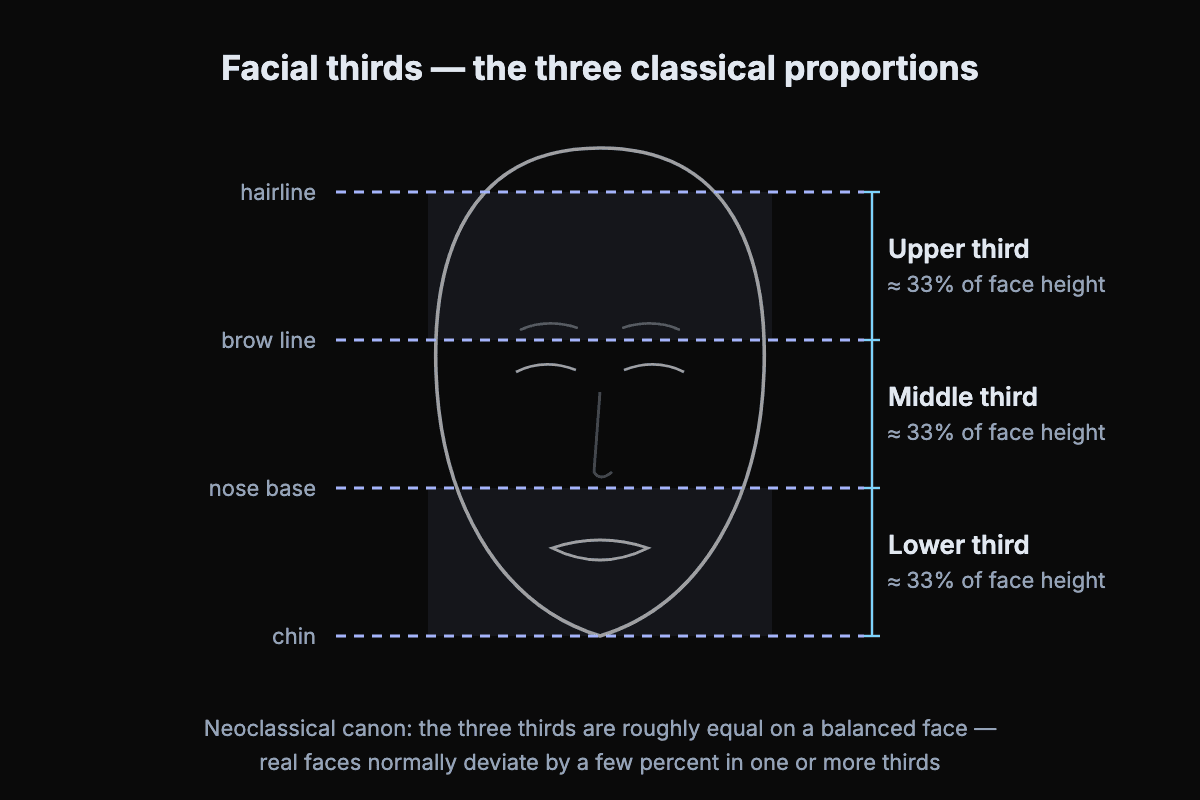
| Third | Reads long as | Reads short as | Compensatory levers |
|---|---|---|---|
Upper Thirdhairline → glabella (between brows)33% ± 2% of total face height | Reads long asLong upper third reads as receding hairline or "forehead heavy." Common after Norwood 2+ or naturally high hairline. | Reads short asShort upper third reads as low hairline or "no forehead." Common with low brow ridges or coarse-textured hair growing forward. | Compensatory leversCut to face shape (curtain bangs, side-fringe), brow positioning via shaping, hair density treatment if recession is the cause.Face shape test → |
Middle Thirdglabella → subnasale (base of nose)33% ± 2% of total face height | Reads long asLong midface — the #1 looksmax-flagged thirds deviation. Reads as elongated, "pulled-down," or vertically asymmetric. Strongly correlated with negative canthal tilt and lower attractiveness ratings. | Reads short asShort midface reads as compact and youthful but can flatten the cheekbones. Less common than long midface but appears in some heart and round face shapes. | Compensatory leversLong midface is largely structural — bone-anchored. Compensatory plays: facial hair to break vertical line, glasses with strong horizontal frame, hair volume up top to balance, makeup contour on cheekbone (women).All face shapes guide → |
Lower Thirdsubnasale → menton (chin tip)33% ± 2% of total face height | Reads long asLong lower third reads as "horse-faced" or chin-heavy. Often paired with mandibular prognathism (jaw forward of upper jaw). High among long-face/dolichocephalic skull shapes. | Reads short asShort lower third reads as a recessed chin or weak jaw. Strongly correlated with mouth-breathing development and low attractiveness ratings, particularly in men. The single highest-leverage third for surgical or restorative work. | Compensatory leversLower third is the most fixable third. Chin filler, jaw surgery (mandibular advancement), orthodontics for occlusion, body-fat reduction to unmask gonial angle, mewing posture for long-term.Jawline angle test → |
8-metric suite
Your complete looksmax scorecard
One AI scan measures all 8 metrics from a single selfie. You've explored one — get the full picture.
6 thirds archetypes — find yours
The pattern your photo lands in tells you whether to fix, compensate, or leave alone.
| Pattern | What it reads as | The play |
|---|---|---|
1:1:1 (perfect thirds) | What it reads asVitruvian baseline. Balanced face read by voters as harmonious. Roughly 1 in 7 faces hit this naturally. | The playDon't fix what isn't broken. Direct effort at single-feature halos (eyes, smile, skin) instead. |
Long midface (>36%) | What it reads asMost common asymmetric pattern in dolichocephalic / long-face skulls. Drags overall harmony score by 8–12 percentile points on average. | The playCompensatory styling — break vertical with facial hair, horizontal-frame glasses, hair-volume top. Surgical fix is rare; LeFort I osteotomy is invasive and only indicated with malocclusion. |
Short lower third (<30%) | What it reads asRecessed chin pattern. Often paired with class II malocclusion and mouth-breathing development. High looksmax leverage — chin work has outsized return. | The playChin filler ($600–1500, instant), genioplasty surgery ($4–8k, permanent), or mandibular advancement orthodontics if young. See /procedure-roi for ranked options. |
Long lower third (>36%) | What it reads asChin-heavy / horse-face read. Often class III malocclusion (lower jaw forward of upper). Less common than short lower third. | The playReduction genioplasty if severe. Beard trimmed shorter under chin (avoid the visual extension downward). Hair volume top to redistribute the read upward. |
Long upper third (>36%) | What it reads asHigh hairline or receding hairline. Reads as forehead-heavy. Can be natural (always had high hairline) or progressive (Norwood pattern). | The playCut frames forehead — curtain bangs, side fringe, textured top. If progressive: minoxidil + finasteride or transplant. Never over-comb back; that exposes more upper third. |
Short upper third (<30%) | What it reads asLow hairline or hair-grown-forward look. Less penalized than the long-third patterns but can read as "primitive" or unrefined frame. | The playPluck/wax forehead-side hair growth, work with a barber on hairline cleanup. Brow positioning matters — over-low brows compound the look. |
Why the mirror lies and the test doesn't
You can't see your own thirds in a mirror — the brain self-anchors on the eyes and back-fills the rest. Most people with long midface or short lower third have no idea until they see a measurement.
The test is brutally honest because the landmark detector has no ego: it places the glabella, subnasale, and menton from raw pixel data and computes the ratio (the upper third is estimated — see how the thirds are measured below).
The test compares your ratio against demographic-matched baselines, not the European 1:1:1 ideal. East Asian faces average ~32:35:33; African ~34:33:33; South Asian ~33:33:34. You're scored against your own group's mean to avoid penalizing natural ethnic variance — your "balance" score reflects how close you are to your demographic median, not how close to a Renaissance Italian.
How the thirds are measured — including the honest part
The scan runs a 68-point facial-landmark detection (iBUG 300-W scheme) — in your browser on desktop, and on mobile the photo is processed in memory by our scan server and deleted immediately after the landmarks are measured, never stored either way.
Two of the three thirds are measured directly from those landmarks: the middle third from the brow-line midpoint down to the base of the nose, and the lower third from the nose base to the chin point.
The upper third is different, and we would rather say so than pretend: the 68-landmark scheme has no hairline point, so the upper third is estimated at 0.95× your measured middle third. The upper-third figure is therefore an approximation, while the middle and lower thirds carry full landmark precision.
Your balance score is 100 minus the summed deviation of each third from the 33% ideal.
Lower-third dominance is also one of the gender-differentiated markers scored on the masculinity test, so if your lower third runs long, that page shows the other side of the same measurement.
If you want to check the math yourself — with a ruler in the mirror or on a printed photo — the classical method uses four landmarks in a vertical chain: trichion (the hairline midpoint), glabella (the smooth point between the brows), subnasale (the base of the nose), and menton (the bottom of the chin).
- Locate the trichion — the midpoint of your natural hairline. This is the landmark our scan has to estimate (the 68-point scheme has no hairline point), which is exactly why a manual check is a useful cross-reference.
- Measure trichion to glabella — hairline down to the point between your brows. That distance is your upper third.
- Measure glabella to subnasale — brows down to the base of the nose. That distance is your middle third.
- Measure subnasale to menton — nose base down to the bottom of the chin. That distance is your lower third. Divide each segment by the trichion-to-menton total to get the three percentages.
What the "ideal" ratio actually is
The classical canon — the one used in cephalometric and orthodontic literature — is three roughly equal thirds, about 33% each. That is the reference line, not a pass mark: as the data section below notes, real faces normally deviate from it, and a deviated third is the common case, not a defect.
Thirds balance is one proportion among many, so matching the equal-thirds canon does not make a face attractive on its own, and missing it does not make a face unattractive.
What our data shows
In that literature, an elongated lower third — above roughly 36% of face height — is the most common imbalance, and faces with all three sections within 2% of equal are uncommon (Farkas & Munro, 1987; Naini, 2011). In other words, a deviated third is the normal case, which is why the result tells you which third and by how much instead of a pass/fail.
The research
| Study | Source | Finding |
|---|---|---|
Vitruvian proportions in facial aesthetics | PMC, 2009 | Across 80 graded faces, voter ratings correlated 0.71 with closeness to 1:1:1 thirds ratio after controlling for symmetry. Long-midface and short-lower deviations had the strongest negative correlation with attractiveness scores. |
Lower facial third in male attractiveness | NIH PMC, 2014 | Pre/post genioplasty patients gained 12.4 percentile points in voter-rated attractiveness on average. The largest gains came from short-lower-third patients who moved from <30% to 32–34% lower third. |
Ethnic variation in facial thirds baseline | Angle Orthodontist, 2018 | Mean thirds ratio in 1,200 patients across ethnicities: European 33.1/33.5/33.4, East Asian 32.2/35.0/32.8, African 34.1/32.7/33.2, South Asian 32.9/33.1/34.0. Voters rated within-group means as more attractive than cross-group ideals. |
Mouth-breathing development and lower third length | AAP, 2020 | Children with chronic mouth-breathing showed 4.2% greater lower-third elongation by age 14 than nasal-breathing controls. The "long face syndrome" pattern strongly predicts adult thirds asymmetry. |
Facial thirds — FAQ
What are facial thirds?
The face divides vertically into three sections — upper (hairline to glabella between the brows), middle (glabella to base of nose), and lower (base of nose to chin tip). The Vitruvian / Renaissance ideal is 1:1:1 — all three roughly equal, each about 33% of total face height.
Voter rating studies consistently rank faces closer to 1:1:1 as more attractive on average, after controlling for symmetry and skin.
How accurate is a photo-based facial thirds test?
On front-facing high-resolution photos with neutral expression, landmark detection places the glabella, subnasale, and menton within 1–2 pixels of orthodontic gold-standard, and the thirds ratio reproducibility runs 96–98% across re-tests of the same photo.
One honest caveat: the hairline is not a detected landmark — the upper third is estimated from the middle third — so the upper-third figure carries more uncertainty than the middle and lower thirds. Photos with the chin tilted up or down degrade the measurement most.
Which third deviation matters most for attractiveness?
Lower third deviations carry the most weight. Voter panels penalize short lower third (recessed chin) more than any other thirds pattern in men, and long lower third (chin-heavy) most in women. Midface deviation is the second-strongest signal — long midface drags ratings by 8–12 percentile points on average. Upper third is the most forgiving; styling can hide most of it.
Can I fix my facial thirds without surgery?
Partially. Lower third is the most fixable: chin filler, jaw posture (mewing), and body-fat reduction can shift the visible proportion noticeably without surgery. Midface is largely bone-anchored — compensatory styling (facial hair, glasses, hair volume) is usually the realistic play. Upper third responds to hair work (cuts, density treatments, hairline shaping). Surgery (LeFort, genioplasty) is reserved for severe deviations with functional issues.
How does facial thirds testing differ from a face shape test?
Face shape (oval, round, square, heart, oblong, diamond) describes the outer contour and width-to-height. Facial thirds measures internal vertical proportions. The two are independent — you can have an oval face shape with a long midface, or a square face shape with perfect 1:1:1 thirds. Together they describe the face in 3D. Run both for a complete read: this test plus the /face-shape-test.
Is the 1:1:1 ratio universal across ethnicities?
The 1:1:1 ideal was derived from European Renaissance proportions and skews toward Caucasian skulls. Cross-ethnic studies show East Asian faces average ~32:35:33 (slightly long midface), African ~34:33:33 (slightly long upper third), and South Asian close to 33:33:34.
RealSmile compares your thirds against demographic-matched baselines to avoid penalizing natural ethnic variance — the score reflects how close you are to your own group's mean, not the European ideal.
Is a long lower third bad?
No single third is "bad" on its own. An elongated lower third — above roughly 36% of face height — is the most common imbalance reported in cephalometric literature (Farkas & Munro, 1987; Naini, 2011), so it is closer to the norm than an outlier; faces with all three sections within 2% of equal are uncommon.
A longer lower third also reads as more mature, and in men it overlaps with masculine markers like jaw dominance. It becomes a styling question mainly when it pairs with a recessed chin — and a beard trimmed shorter under the chin visually rebalances it without changing anything structural.
Why is my lower third so long?
Usually because that is simply how your skeleton grew — an elongated lower third is the most common thirds imbalance in cephalometric literature (Farkas & Munro, 1987; Naini, 2011). Developmental research also associates longer lower-face growth with chronic mouth breathing and malocclusion during childhood; that is a published association, not a diagnosis.
In adults the proportion is skeletal and stable, so what you can realistically change is the read: beard shape, hair volume up top, and photo angle all shift how long the lower third appears.
Can you measure facial thirds without seeing the hairline?
Yes — this test never uses the hairline at all. The 68-point landmark scheme has no hairline point, so the middle third (brow line to nose base) and lower third (nose base to chin) are measured directly, and the upper third is estimated at 0.95× the middle third.
That means bangs, a hat line, or a receding hairline won't break the scan — but it also means the upper-third figure is an approximation, while the middle and lower thirds carry full landmark precision.
What's the relationship between facial thirds and the golden ratio?
The golden ratio (1.618:1) describes width-to-height and feature-spacing relationships. Facial thirds describes vertical thirds within total face height. They are independent measures. A face can hit 1:1:1 thirds without hitting golden ratio, and vice versa. RealSmile scores both — see the /golden-ratio page for the geometric companion to this test.
Honest caveats
- The upper third is estimated, not measured — the 68-point landmark scheme has no hairline point, so it is derived at 0.95× your middle third. A naturally high or low hairline can make your mirror impression differ from the reported upper third by a few percentage points.
- Chin tilt up or down skews lower-third measurement. Use a neutral, eye-level photo for the most accurate read.
- Heavy beard coverage hides the chin tip and inflates the lower third. Trim or use a clean-shaven photo for an accurate baseline.
- Thirds is a single dimension of facial harmony. A balanced thirds ratio doesn't guarantee high attractiveness — it removes one penalty. The other 16 metrics still matter.
Background reading: the rule of facial thirds and the midface ratio in our glossary, plus how the 17 metrics average out across real scans in the State of Looksmaxxing 2026 report.
Terms measured on this page
- Rule of Facial ThirdsThe rule of facial thirds divides the face vertically into three equal regions — forehead, midface, and lower…
- Neoclassical Facial CanonsThe neoclassical canons are a set of nine ideal facial proportions formalized in 18th-century European art — u…
- Midface RatioThe midface ratio compares the vertical height of the midface (brow to upper lip) to other facial thirds — a m…
Test Your Other Metrics
Each test measures a different facial metric. Run them all to get the full picture.
Jawline Test
Gonial angle + definition
Hunter Eyes Test
Canthal tilt + hooding
Symmetry Test
Left-right balance score
Face Shape Test
Oval, square, heart & more
Canthal Tilt Test
Eye angle in degrees
FWHR Calculator
Width-to-height ratio
Masculinity Test
5 masculine markers scored
Am I Ugly Test
Honest AI face analysis
Get the human-written photo audit — $19.99, 5 pages, returned in 48h.
Thirds is one metric. The audit reads your full face, ranks what to address first, and writes a personalized 5-page report on the highest-leverage moves (procedure ROI included).
Get the $19.99 photo audit →Premium Dating Photo Audit · Delivered in 1–2 minutes
Get your dating photos audited.
Upload up to 10 photos and see your #1 lead photo + its score free. Then unlock the full written audit — every metric scored on every photo, what to delete, a per-photo reshoot brief, a 20-dater AI voter panel + downloadable PDF — for $19.99.
✓ 1–2 min delivery · ✓ 17 metrics scored · ✓ Lead-photo verdict · ✓ Stripe secured