What is facial width-to-height ratio (FWHR)?
Facial width-to-height ratio (FWHR) is a measurement of facial structure calculated by dividing face width by face height. Specifically: bizygomatic width (the horizontal distance between the left and right cheekbone landmarks) divided by upper face height (vertical distance from the upper lip to the midpoint between the brows).
The formula: FWHR = bizygomatic width ÷ upper face height
A higher FWHR indicates a wider, shorter upper face — characteristic of strong cheekbones and a compact midface. A lower FWHR indicates a narrower or taller upper face. Research has linked FWHR to testosterone exposure, dominance, aggression, and attractiveness ratings, making it one of the most-studied single facial metrics in psychology and evolutionary biology.
It is still one metric of many, though — if you want the whole-face read, you can see where your face ranks on a single 1–10 scale.
The metric became prominent after Carré and McCormick's 2008 study finding correlations between FWHR and aggressive behavior, and has since been replicated and extended by dozens of labs studying everything from financial risk-taking to CEO success rates.
How FWHR is calculated
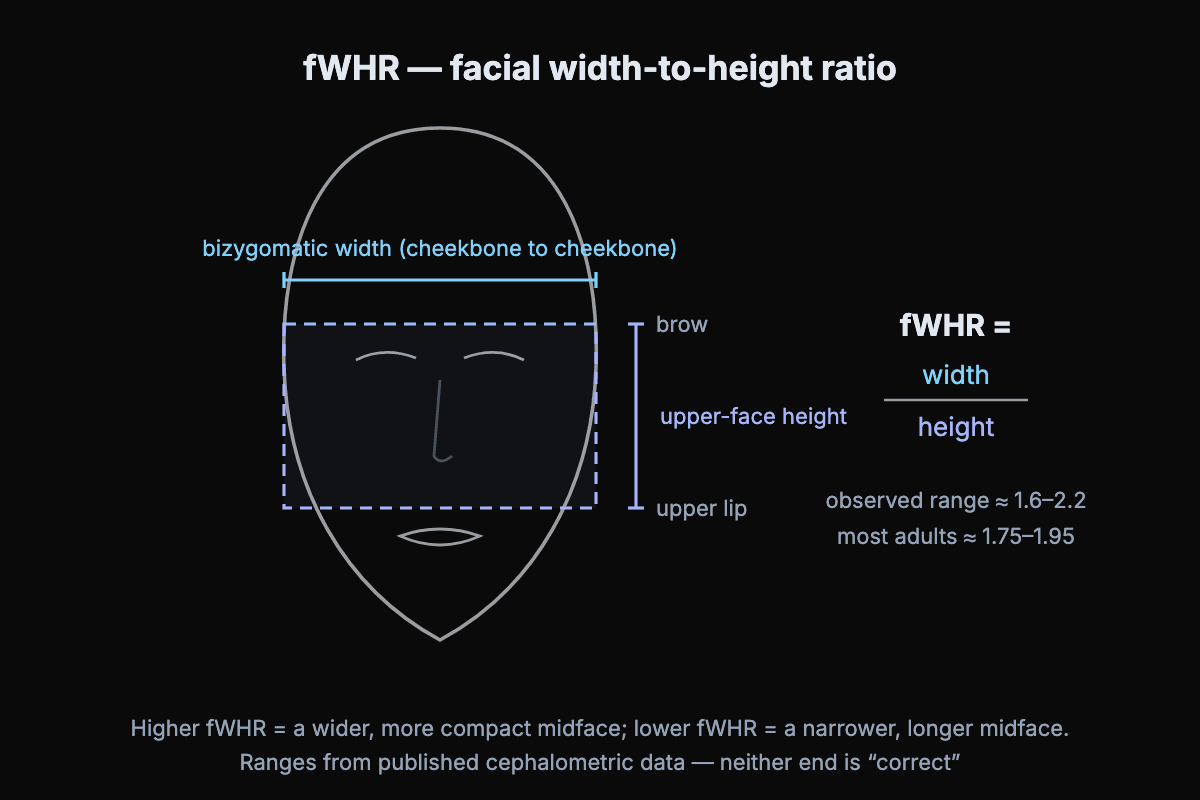
| Measurement | What is measured |
|---|---|
| Bizygomatic width | The maximum horizontal width between the two zygion landmarks — the most lateral points of the zygomatic arches (cheekbones). Measured on a front-facing photo with head level and eyes forward. |
| Upper face height | The vertical distance from the upper lip border (stomion superius) to the midpoint between the two inner brow corners (glabella). This captures the upper facial height independently of forehead and chin. |
What your FWHR score means
| Range | What it means |
|---|---|
| ≥ 2.2High FWHR | Very wide relative to height. Associated with strong dominance perceptions, high testosterone signaling, and a distinctly masculine or powerful facial appearance. Common in athletes and individuals rated as high-dominance. Can read as aggressive if combined with other features. |
| 1.9 – 2.1Above average FWHR | The sweet spot in most attractiveness research for men. Wide enough to signal facial structure and masculinity without reaching the extreme range. Often described as the "ideal" masculine facial width-to-height relationship. |
| 1.7 – 1.9Average FWHR | Most common range in the general population. Neither strongly masculine nor feminine in width-to-height terms. Rated as average attractiveness. For women, this range (particularly 1.7-1.8) is often rated as most feminine and attractive. |
| < 1.7Low FWHR | Narrow relative to height — longer upper face, narrower cheekbones, or both. Associated with a more refined or delicate facial appearance. In women, sometimes preferred for high-fashion aesthetics. In men, associated with lower dominance perceptions in research. |
A higher ratio does not mean more attractive. It is a proportion, not a verdict.
FWHR readings from 1.6 to 2.2 — where each value sits
Looking up a specific reading? Each row below places one value against the commonly cited adult average of roughly 1.8–1.9. These are relative positions, not quality judgments — the ratio is a proportion of your face, not a score.
| Reading | Where it sits |
|---|---|
| 1.6 FWHR | Noticeably below the commonly cited adult average of roughly 1.8-1.9. The upper face reads narrower or taller relative to cheekbone width than most measured adults. |
| 1.7 FWHR | Somewhat below the typical average band. Plenty of adults measure here — it reads as a slightly narrower or longer upper face. |
| 1.8 FWHR | At the lower edge of the commonly cited average band of roughly 1.8-1.9. A very ordinary reading. |
| 1.9 FWHR | At, or just above, the commonly cited adult average of roughly 1.8-1.9. One of the most common readings in measured samples — neither narrow nor unusually wide. |
| 2.0 FWHR | A bit above the typical average band. The face reads somewhat wider relative to upper-face height than most measured adults. |
| 2.1 FWHR | Above average. Wider-than-typical proportions, though readings in this range still appear regularly in measured samples. |
| 2.2 FWHR | Near the upper end of what most measured samples report. A distinctly wide upper face relative to its height. |
Remember the measurement itself is photo-sensitive: chin tilt and lens distance shift the reading. Scan a level, front-facing photo before comparing your value to these rows.
What does your FWHR look like?
These reference proportions show how the bizygomatic-width-to-upper-face-height ratio shifts. The schematic ovals below isolate just the two measurements that define FWHR — cheekbone width (horizontal line) and upper-face height (vertical line, brow to upper lip).
Low FWHR
~1.75
Narrow lower-male / typical female range.
Median FWHR
~1.95
Population median — most adults sit around 1.9–2.0.
High FWHR
~2.15
Wider face — most associated with dominance perception (Geniole 2015).
Schematic ovals — not real measurements. Actual FWHR runs on landmark points from your photo, not these references.
High FWHR vs low FWHR — perception tradeoffs side-by-side
Existing research finds high and low FWHR both prime perceptions — but in opposite directions. Pick the trade-off honestly.
| Trait / Perception | High FWHR (~2.05+) · Low FWHR (~1.80-) |
|---|---|
| Dominance perception | HighHigher — rated as more dominant in stranger ratings (Geniole 2015 meta-analysis).LowLower — rated as less dominant in the same panels. |
| Trustworthiness perception | HighLower — wider faces rate slightly less trustworthy in some study panels.LowHigher — narrower faces often rate as more approachable. |
| Aggression cue | HighStronger — correlated with self-reported and behavioral aggression in men (Carré & McCormick 2008).LowWeaker — less aggression signal carried by the face. |
| Leadership-success correlation | HighHigher — among Fortune 500 male CEOs, a wider face went with better firm financial performance (Wong, Ormiston & Haselhuhn 2011).LowLower in this specific dataset — but both extremes contain successful people. |
| Femininity read (women) | HighLower — ratios above ~2.0 read as more masculine.LowHigher — narrow ratios are often rated as more feminine in attractiveness panels. |
| Photographic robustness | HighStable — wide cheekbones photograph similarly across angles.LowSensitive — narrow ratios distort more under camera-tilt and lens choice. |
The research on FWHR
| Study | What it found |
|---|---|
| Carré & McCormick (2008) | FWHR predicts aggressive behavior in hockey playersThe foundational FWHR study found that in a sample of 90 NHL hockey players, FWHR correlated significantly with the number of penalty minutes received — a proxy for aggressive behavior. Players with wider faces (higher FWHR) averaged more penalties. This finding launched a decade of research on FWHR and behavioral outcomes. |
| Wong, Ormiston & Haselhuhn (2011) | CEO FWHR predicted firm performanceAnalyzing photos of Fortune 500 CEOs, this study found that CEO FWHR significantly predicted company financial performance. CEOs with higher FWHRs led companies with better ROA (return on assets). The researchers proposed that FWHR signals dominance traits that translate to effective leadership in competitive environments. |
| Lefevre et al. (2012) | FWHR correlates with testosterone in menThis study found that FWHR in adult men correlated with testosterone-to-cortisol ratios, providing a biological mechanism for earlier behavioral findings. Higher FWHR was associated with higher testosterone and lower cortisol, suggesting facial width is a genuine androgen signal rather than just a learned association. |
| Limitations | FWHR research has faced replication challengesLater meta-analyses found mixed results for FWHR's predictive power. A 2018 meta-analysis by Geniole et al. found that while the FWHR-aggression link was real, effect sizes were smaller than initial studies suggested and moderated by context. FWHR is a meaningful facial metric but should not be over-interpreted as destiny — it is one signal among many. |
Can you change your FWHR?
Bizygomatic width is determined by cheekbone structure, which is genetic and fixed in adulthood. However, effective FWHR can be influenced by factors that change face height or apparent cheekbone prominence.
| Lever | What it does |
|---|---|
| Reduce body fat↑ FWHR (most impactful) | Buccal fat and facial fat pads increase face height and obscure cheekbone definition. Reducing body fat below 15% sharpens cheekbone angles and decreases effective face height — both increase your measured FWHR. |
| Mewing / tongue posture↑ FWHR (long-term, unproven for adults) | Proper tongue posture is claimed to influence maxillary development. Evidence is primarily anecdotal and most convincing for adolescents still developing. For adults, effects if any are very gradual. |
| Hairstyle↑ or ↓ perceived FWHR | Hairstyles with volume at the temples increase perceived width; tall hairstyles increase perceived height. Volume on the sides (e.g., side-part styles) can enhance the appearance of a wider face. |
| Cheek filler↑ FWHR (temporary) | Hyaluronic acid filler placed at the zygomatic arch can enhance cheekbone projection and apparent width. Effects last 12-18 months. A popular cosmetic procedure for those seeking a higher FWHR appearance. |
Calculate your FWHR now
Our AI measures bizygomatic width and upper face height from a selfie, one of 17 metrics in the same scan. Your exact FWHR ratio and its 0-100 score are in the full report.
Get my FWHR score →FWHR in 60 seconds — without the dominance hype
The episode as straight text — no fluff, no dodge:
What is your facial width to height ratio? And does a wider face really mean more dominant?
It compares how wide your face is, across the cheekbones, to its height from the brows down to the top lip.
A commonly cited range, not a law. A higher ratio does not mean more attractive. It is a proportion, not a verdict.
Tip your chin down and the face reads wider. That is the camera, not your skull.
Is it fixable? Partly. Bone sets your width. But the ratio reads narrower as body fat drops and the face lengthens.
A hairstyle with height on top, and a lens at eye level, change how wide the face reads in a photo. Not your bone.
See how yours measures. One of seventeen measurements, free, at realsmile.online.
Frequently asked questions
What is FWHR?
FWHR (facial width-to-height ratio) is bizygomatic width divided by upper face height. A higher ratio means a wider, shorter upper face. Early studies linked it to dominance perceptions and aggression, but later large-sample work found those links weak or absent — treat it as a proportion measurement, not a personality or testosterone readout.
What is a good FWHR score?
There is no "good" FWHR — a higher ratio does not mean more attractive, and the commonly cited ranges are population descriptions, not targets. Average FWHR across most populations is roughly 1.7-2.0 (men typically read slightly higher than women). Treat your number as a proportion of your face, not a score to chase.
How is FWHR measured from a photo?
FWHR is calculated by measuring bizygomatic width (cheekbone to cheekbone at the widest point) and dividing by upper face height (upper lip to mid-brow). Our AI detects these landmarks automatically from a selfie.
Does FWHR predict aggression?
Research shows a correlation between high FWHR and aggressive behavior and dominance perceptions. However, effect sizes are modest and individual variation is large. FWHR is a signal, not a determinant.
Is 1.9 FWHR high?
Not really — 1.9 FWHR sits at, or just above, the commonly cited adult average of roughly 1.8-1.9, so it is a typical reading rather than an unusually high one. Values start reading as distinctly wide closer to 2.1-2.2. Either way the ratio is a proportion of your face, not a score: a higher FWHR does not mean more attractive.
Can I increase my FWHR?
Bone structure is fixed in adulthood, but reducing body fat (which decreases effective face height and reveals cheekbone definition) can meaningfully increase your measured FWHR. Hairstyle and cheek filler can also alter the perceived ratio.
8-metric suite
Your complete looksmax scorecard
One AI scan measures all 8 metrics from a single selfie. You've explored one — get the full picture.
Premium Dating Photo Audit · Delivered in 1–2 minutes
Get your dating photos audited.
Rank 2 to 6 photos free (your first 3 are scored free) and see which one should lead. Then unlock the full written audit on up to 10 photos — each photo ranked with its strongest and weakest metrics, what to delete, three reshoot fixes, a 20-dater AI voter panel + downloadable PDF — for $19.99.
✓ 1–2 min delivery · ✓ 17 metrics measured · ✓ Lead-photo verdict · ✓ Stripe secured