Sample report · Example data — not a real user
Know what you can change — and what's bone
Every step in the report's per-metric action plans carries an honest label: Real change, Photo only or Can't change, so you know which suggestions concern grooming, photo presentation or structure.
Each measurement also has a tier.On this sample: 2 fixable · 5 partly fixable · 8 structural
Out of the 15 measurements this example photo supports. Your split depends on your own face.
What the report gives you
- A reading and a plain-English explanation for every measurement your photo supports (typically 15 of the 17)
- Per-metric guides plus actions selected from supported readings
- Three starting actions and a supported four-week photo plan
- A PDF you keep — length varies with supported output
- One payment of $14.99, with a 7-day money-back guarantee
Below shows the report's sections with example readings. Your actions and PDF length depend on the measurements your own photo supports.
Page 1 — Cover Example data
Confidential · Facial Analysis Report
Facial Analysis Report
Report ID: RS-SAMPLE (example scan)
Generated: October 24, 2026
Your Face Score
How attractive real people tend to rate your face in this photo — validated on 1,566 human-rated faces (r≈0.8). It reflects the shot, not a verdict on you.
Free with every scan — this number is not behind the paywall. The full report adds the per-metric readings, fixability tiers and the plan below.
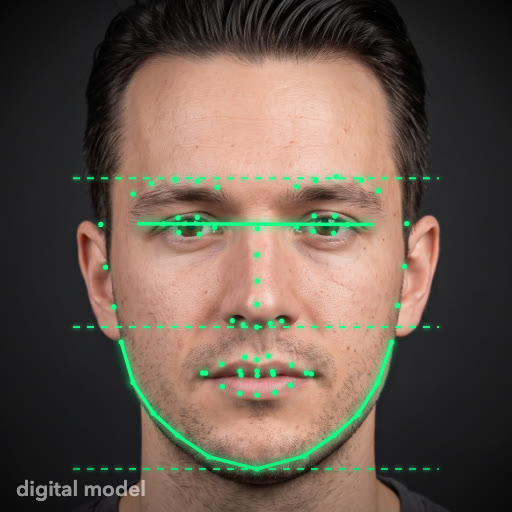
Measurement Map
17 proportion measurements — a map of your features, not a rank or attractiveness score. There is deliberately no overall geometry number: attractiveness isn't a geometry average.
Facial Archetype
Developing
Category Breakdown
65
eyes
56
jawline
68
proportions
63
symmetry
Page 2 — How to Read This Report
How to Read This Report
- Each metric is a numerical measurement of a specific facial geometry — e.g. canthal tilt is the angle in degrees between your inner and outer eye corners; FWHR is your facial width divided by your upper-face height.
- Each metric score places your measurement against the first scans of about 2,100 RealSmile users, so 50 is the median scanner. The ideal range under each metric is shown for context, so a reading can sit inside it and still score below 50. 85+ = Elite, 70-84 = Above average, 50-69 = Average, below 50 = Below average.
- Every metric carries an honest fixability tier: Fixable (grooming and presentation suggestions, without a guaranteed outcome), Partly fixable (posture, body fat and angle move the look; bone caps it), or Structural (set by bone — you get the honest capture playbook, never a false promise).
- A lower measurement score is a reading against its reference, not a defect or proof it can be changed. The four-week plan selects supported actions and can focus on consistent photos.
- Compare photos with a consistent setup. A different reading can come from the photo; it does not by itself prove a physical change.
Pages 3-6 — Detailed Metric Analysis (3 of 15 shown in full) Example data
Per-metric breakdown: measurement, honest fixability tier, and the action
Canthal Tilt
2.7°
38/100
Ideal: 4–7°
What this means: Canthal tilt here is 2.7° — the angle between the inner and outer eye corners. Positive tilt (outer corners higher) creates the "hunter eyes" / alert-gaze signal. It scores 38 because it sits below most RealSmile scanners, and it is under the scan's 4–7° ideal range, so the eye area reads neutral rather than sharp.
Structural: Set by orbital bone shape — not changeable without surgery.
Your action: Camouflage: lens at forehead height + 5-10° chin tuck fakes a positive tilt (the standard editorial pose).
Facial Width-to-Height Ratio
1.72
54/100
Ideal: 1.85–2.1
What this means: FWHR here is 1.72 — bizygomatic width divided by upper-face height. In men a wider FWHR predicted aggressive behaviour (Carré & McCormick, 2008), and observers judge wider faces as more dominant (Geniole et al., 2015). This example sits below 1.85, where the scan's ideal range for men starts.
Partly fixable: Skull width is fixed; hair and, for some people, weight change how wide the face reads.
Your action: A hairstyle with height on top lengthens the face. If you have weight to lose, slow fat loss also narrows how wide it reads; it is not a reason to diet if you are already lean or still growing.
Facial Symmetry
96%
60/100
Ideal: 92%+
What this means: This example face shows 96% bilateral symmetry — measured by mirroring landmarks across the facial midline. Grammer & Thornhill (1994) were the first to show that facial symmetry raises attractiveness ratings.
Partly fixable: Most "asymmetry" is asymmetric lighting + angle, not your bone.
Your action: Front-on, single frontal light at eye level. Side or overhead light manufactures apparent asymmetry your face does not have; even front light removes that part of the reading.
Every measurement in the report Example data
Every metric your photo supports gets a score, an ideal range, and an honest fixability tier
The three cards above show the full per-metric depth. Here is the complete index — every metric your photo supports (15 in this example) receives the same treatment in the report. Eye Spacing and Jawline Angle are never scored, so they show as not measured. Tiers below are pulled from the live product data, not marketing copy.
- Facial SymmetryPartly fixable60
- Canthal TiltStructural38
- Facial Width-to-Height RatioPartly fixable54
- Facial Thirds BalanceStructural63
- Eye SpacingStructuralnot measured
- Jawline AnglePartly fixablenot measured
- Nose ProportionStructural70
- Lip RatioPartly fixable68
- Midface RatioStructural72
- Eye Shape (Hunter Eye Index)Partly fixable74
- Brow ArchFixable67
- Philtrum RatioStructural64
- Chin ProportionStructural60
- Brow-Eye ProximityFixable79
- Jaw Taper (V-Shape)Partly fixable55
- Facial Proportion BalanceStructural70
- Orbital Tilt SymmetryStructural66
Legend: Fixable = grooming/skin/technique, changes in weeks · Partly fixable = lifestyle + angle move the look, bone caps it · Structural = set by bone; the report gives the honest capture playbook instead of a false promise.
Three starting actions Example data
Your first three actions from the plan
These are selected the same way as the downloadable report. This example has no supported grooming target, so its starting actions focus on repeatable photos. Your own readings may produce different actions.
Hold the phone at eye level, at least an arm’s length away. A phone held close makes the nose look wider.
Keep a neutral face: relaxed brows, relaxed mouth, no smile. Raised brows or a squint change the eye readings.
Then note your setup: same window, same time of day, same distance.
Measurement guide — Canthal Tilt
An example per-metric guide
This section is rendered from the live product content — the same source your real report pulls from. Note what it does not do: no bone-change promises, no miracle routines. It tells you what is camera, what is lifestyle, and what is structure.
Canthal tilt is structural. The angle of the outer eye corner is set by the orbital bone, so the win here is how it photographs.
- 1
Nothing cheap changes the actual angle. Real correction is surgical, and everything short of that is presentation. Knowing that saves you money and lets you put effort where it pays: the photo read. Can't change
- 2
Use the standard editorial pose: lens slightly above eye level, around forehead height, and tuck the chin 5 to 10 degrees. Looking up at the camera lifts the outer corners visually and reads as a more positive tilt in the shot. Photo only
- 3
Light from the front, soft and diffused. Overhead light shadows the outer eye corners and drags the read downward. Sleeping on your back also helps, since a side-slept, puffy lower lid makes one eye read lower in morning photos.
In the on-screen report, this metric's action plan shows the first 2 steps, labeled as above.
Page 7 — Your Starting Point Example data
Your Starting Point
YOUR BASELINE TODAY
15 measurements, saved
Retake under the same neutral setup and compare your readings, metric by metric
A reading can change because the photo changed. The report does not predict a point gain or promise a visible change.
Four-week plan — all four weeks shown Example data
A four-week plan selected from supported readings
The plan separates everyday grooming, styling photos and neutral measured retakes. This example focuses on photo consistency and framing for structural readings; it does not promise to change bone structure.
Before your next measurement
- Stand facing a window, so soft light falls evenly on both sides. Avoid overhead light or a lamp off to one side.
- Hold the phone at eye level, at least an arm’s length away. A phone held close makes the nose look wider.
- Square your shoulders, look straight into the lens, and keep your head level.
- Keep a neutral face: relaxed brows, relaxed mouth, no smile. Raised brows or a squint change the eye readings.
- Wipe the lens and tap to focus on your face.
- Then note your setup: same window, same time of day, same distance.
Use a neutral expression for measured retakes. The styling-photo suggestions below are separate from that setup.
Week 1
Photo setup and consistent retakes
Styling photos
- Camouflage: hairline/brow framing and hair height visually rebalance a long or short third.
- Camouflage: a relaxed, slightly parted mouth and lens at eye level shorten the apparent philtrum.
Week 2
Photo setup and consistent retakes
Use the same photo setup and keep your routine consistent.
Check-in
Retake with the same neutral setup. A different reading can come from a different photo; use your account’s comparison before treating it as a change.
Week 3
Photo setup and consistent retakes
Use the same photo setup and keep your routine consistent.
Week 4
Photo setup and consistent retakes
Use the same photo setup and keep your routine consistent.
Check-in
Retake with the same neutral setup. A different reading can come from a different photo; use your account’s comparison before treating it as a change.
This is the full four-week schedule for the example readings. Your plan depends on the measurements your photo supports.
It also comes as a PDF you keep
The report renders in your browser and also downloads as a multi-page document. These are the actual pages the generator produces — not a brochure of them.
Cover
Your analyzed photo, Face Score percentile, and facial archetype
Executive summary
Your starting point, category breakdown, and how to read the report
Detailed metric analysis
Every metric your photo supports (typically 15 of the 17) with its reading, score and reference range; the rest are marked not measured
Three starting actions
Supported grooming or styling actions, with consistent-photo steps when no grooming target qualifies
Four-week photo plan
The same supported actions, setup and four weeks as the on-page plan
Unlocking also raises your daily scan limit and keeps every rescan side by side, so a change you make in week three is measured against the same baseline rather than a fresh guess.
Other ways to get photo feedback
| Source | Price | Format |
|---|---|---|
| QOVES | Yearly membership | Team-prepared analysis and plan; see its current scope and delivery terms |
| Photofeeler | Free voting Karma or paid Credits | Human photo-trait feedback; voting and score methods differ from an AI Face Score |
| FaceIQ Labs | Free tier; monthly or annual paid plans | Free side-profile feedback; broader analysis and tools depend on the tier |
| RealSmile Full Report | $14.99 standard price, one-time | Supported measurements, four-week photo plan and PDF; Pro membership is separate |
Ready to see your own breakdown?
Start with the free scan — no signup, and your photo is deleted right after analysis unless you choose to save it. You'll see your Face Score and your standout metric free, and decide about the full report only after that.
Free scan · No signup · Photo deleted after analysis unless you save it